
HMAS Sydney
1912 Chatham-class light cruiser
Vessel Wikidata
* This information from Wikidata is available under the Creative Commons Attribution-ShareAlike License
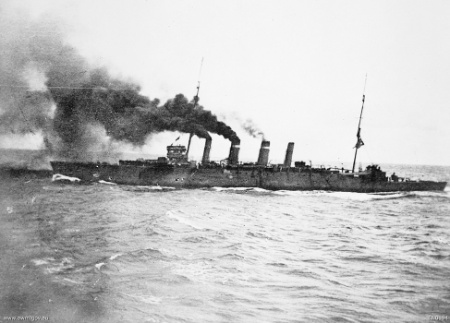
HMAS Sydney was a Chatham-class light cruiser of the Royal Australian Navy, launched in 1912 and commissioned in 1913. She was a Town-class cruiser with a standard displacement of approximately 5,400 tons and measured 456 feet 9.75 inches (139.2 meters) in overall length, with a beam of nearly 49 feet 10 inches (15.19 meters) and a draught of 19 feet 8 inches (5.99 meters). Her propulsion system consisted of coal- and oil-fueled Yarrow boilers connected to Parsons geared turbines, delivering 25,000 shaft horsepower, which allowed her to reach a maximum speed of about 25.7 knots (47.6 km/h). Her crew numbered around 376 during peacetime, increasing to 475 during wartime. The ship’s armament comprised eight single BL 6-inch Mark XI guns, supported by a 3-inch anti-aircraft gun, ten machine guns, two 21-inch torpedo tubes with seven torpedoes, and depth charges for anti-submarine warfare. Her armor included a 3-inch thick side belt amidships, tapering to 1.5 inches at the bow and stern, along with protective deck armor and an armored conning tower. Sydney’s notable service began shortly after her commissioning, supporting Australian military operations in World War I. She participated in the capture of German colonial assets and gained fame for her engagement against the German cruiser SMS Emden at the Battle of Cocos on 9 November 1914, where she sank Emden after a fierce battle, firing around 670 rounds and claiming approximately 100 hits. During this engagement, she sustained 16 hits, with three crew members killed and thirteen wounded. Sydney also became the first Australian warship to launch an aircraft from a rotatable platform, pioneering naval aviation. Throughout WWI, Sydney served in various theaters, including the North Atlantic, and participated in the surrender of the German High Seas Fleet in 1918. She was awarded the battle honor "Emden 1914," later supplemented with honors for Rabaul and the North Sea. Decommissioned in 1928, she was broken up in 1929; however, parts of the ship, including her bow, foremast, and guns, have been preserved as monuments and displays, commemorating her service and Australian naval history.
This description has been generated using GPT-4.1-NANO based on the Vessel's wikidata information and then modified by ShipIndex.org staff.