
USCGC Bedloe
Vessel Wikidata
* This information from Wikidata is available under the Creative Commons Attribution-ShareAlike License
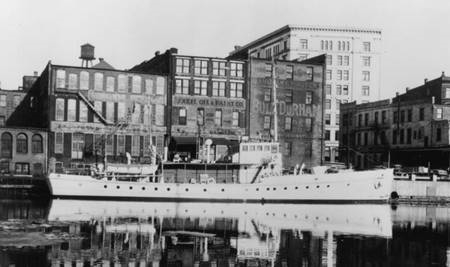
The USCGC Bedloe was an Active-class cutter of the United States Coast Guard, built to support law enforcement, search and rescue, and wartime operations. Laid down on December 2, 1927, and launched on February 14, 1927, she was constructed by the American Brown Boveri Electric Corporation in Camden, New Jersey. The vessel measured approximately 125 feet (38 meters) in length, with a beam of 22 feet 6 inches (6.86 meters) and a draft of 7 feet 6 inches (2.29 meters). Designed as a "mothership" to enforce Prohibition laws along the coast, she was capable of extended at-sea patrols and could expand berthing space with hammocks if necessary. Initially stationed at Boston to combat Prohibition-related smuggling, Bedloe was reassigned to Milwaukee in 1935, where she conducted routine patrols, search and rescue, and fisheries enforcement in the Great Lakes. In 1940, during World War II, she was refitted with a heavier main gun and depth charges at Hoboken, New Jersey, to bolster her military role. Subsequently transferred to the Eastern Sea Frontier, she was redesignated from WPC to WSC in February 1942 and served primarily as a convoy escort along the U.S. East Coast. Notably, Bedloe participated in rescue operations, including the rescue of 16 survivors from the torpedoed SS Gulf Trade in March 1942. On June 1, 1943, she was renamed USCGC Bedloe to avoid confusion with the aircraft carrier USS Antietam (CV-36). Her service ended tragically during the Great Hurricane of 1944, when she was deployed to assist in towing the torpedoed Liberty ship SS George Ade. The storm, with waves reaching 100–125 feet, caused her to founder around 1:30 PM on September 14, 1944, in waters approximately 22 miles east of the Outer Banks. The sinking resulted in the loss of 26 crew members out of 38. Only 12 survived after abandoning ship, with the majority succumbing to exhaustion or exposure over the 51 hours they spent in the stormy sea. The wreck lies in 144 feet (44 meters) of water, almost completely intact and on its side, covered with sea life. The vessel's depth charges were never recovered, likely removed by the Navy. The loss of Bedloe and her crew marked a significant tragedy in Coast Guard history, with a total of 47 Coast Guardsmen perishing in the twin sinkings related to the storm.
This description has been generated using GPT-4.1-NANO based on the Vessel's wikidata information and then modified by ShipIndex.org staff.