
Japanese cruiser Chōkai
1931 Takao-class cruiser
Vessel Wikidata
* This information from Wikidata is available under the Creative Commons Attribution-ShareAlike License
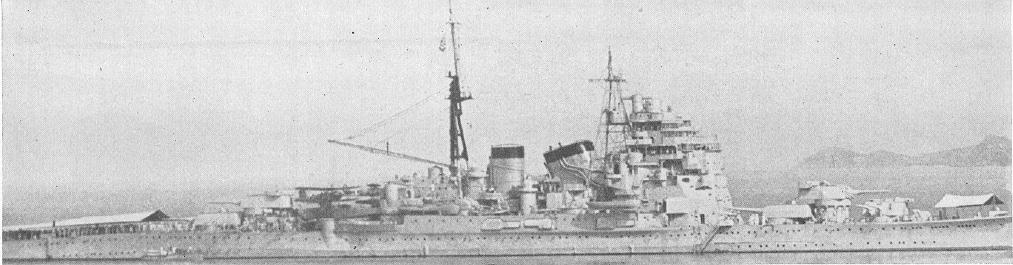
The Japanese heavy cruiser Chōkai was a Takao-class vessel built in 1932 by Mitsubishi in Nagasaki, designed to fulfill Japan’s strategic goal of decisive naval battles. She measured approximately 203.8 meters (669 feet) in length, with a beam of 20.4 meters (67 feet) and a draft of 6.32 meters (20.7 feet). Displacing around 16,875 tons, Chōkai was powered by 12 Kampon boilers driving four geared turbines, allowing her to reach a top speed of 35.25 knots. Her armor included a 127 mm side belt and a 35 mm armored deck, with the bridge protected by 10 to 16 mm armor. Armed with ten 20 cm/50 3rd Year Type naval guns in five twin turrets, she boasted the heaviest armament of any heavy cruiser at the time. Her secondary armament consisted of four 12 cm dual-purpose guns and eight 533 mm torpedo tubes in twin launchers, with reloads. Her anti-aircraft defenses were initially limited, comprising two 40 mm guns and two machine guns, but were later upgraded to include 38 Type 96 25 mm guns. She retained her original 12 cm guns and four twin torpedo tubes, unlike her sister ships which received more extensive refits. Chōkai participated actively in the Pacific War, supporting invasions such as Malaya, the Dutch East Indies, and Borneo. Notably, she was involved in the Battle of Savo Island (August 1942), where she, alongside other Japanese cruisers, inflicted a significant defeat on Allied forces, sinking four cruisers including USS Astoria, USS Vincennes, USS Quincy, and USS Canberra. She sustained damage during this engagement but returned to Rabaul for repairs. Throughout the war, Chōkai engaged in night battles around the Solomon Islands and later served as flagship of Cruiser Division Four, participating in the Battle of the Philippine Sea and the Battle of Leyte Gulf. On October 25, 1944, during the Battle off Samar, Chōkai was hit by US gunfire and a torpedo, which caused fires and disabled her. She was ultimately scuttled on the same day by destroyer torpedoes after suffering critical damage from an American aircraft bomb. Her wreck lies upright at a depth of over 5,000 meters in the Philippine Deep, discovered in 2019 by the RV Petrel expedition. Chōkai’s service exemplifies Japan’s naval strength and tactical strategies during World War II.
This description has been generated using GPT-4.1-NANO based on the Vessel's wikidata information and then modified by ShipIndex.org staff.