
SS City of Rio de Janeiro
American passenger ship built in 1878; sank in 1901
Vessel Wikidata
* This information from Wikidata is available under the Creative Commons Attribution-ShareAlike License
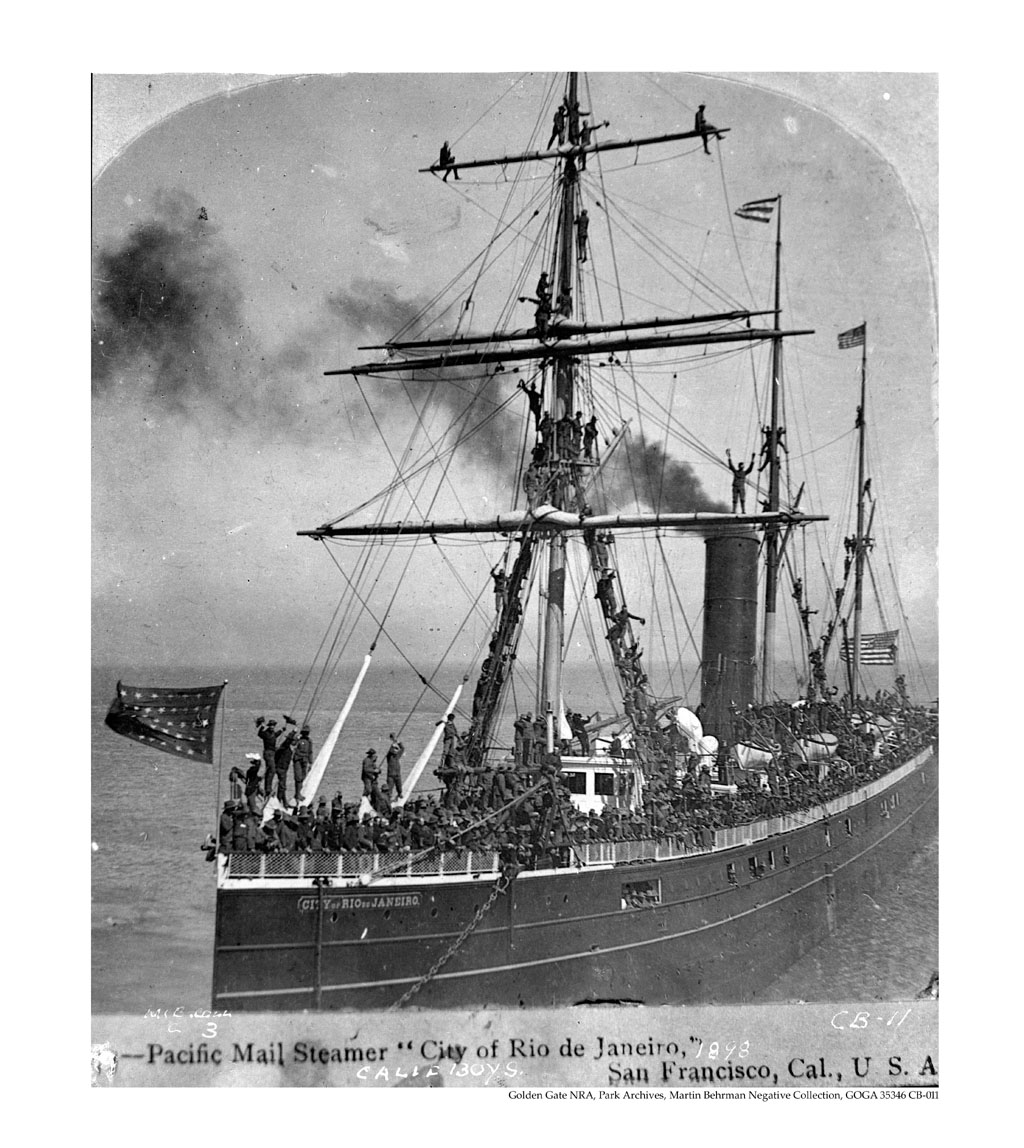
The SS City of Rio de Janeiro was an iron-hulled steam-powered passenger vessel launched on March 6, 1878. Designed primarily for transpacific service, she initially operated for the United States & Brazil Mail Steamship Company, connecting Brazil and the United States. Due to unprofitability, she was sold in 1881 to the Pacific Mail Steamship Company, where she was refitted to serve as an ocean liner traveling between San Francisco, Honolulu, Yokohama, and Hong Kong. Her construction predated the use of watertight bulkheads, which contributed to her rapid sinking in 1901. The ship measured a typical size for her era, with an iron hull supporting steam-powered propulsion, though exact dimensions are not specified. Throughout her service, she encountered notable incidents, including a brief period in 1898 when the U.S. government leased her to ferry troops during the Spanish–American War. She also carried distinguished passengers, such as Alfred Daniel Jones, U.S. Consul General in Shanghai, who died aboard in 1893 after experiencing a mental breakdown. On February 22, 1901, the City of Rio de Janeiro met her tragic end while navigating through heavy fog at the entrance to San Francisco Bay. She struck a submerged reef near Fort Point, with damage severe enough to cause her to sink stern first within ten minutes. The collision ruptured much of her underside, and because she lacked watertight bulkheads, her sinking was swift. Of approximately 220 people aboard, only about 82 survived, rescued by nearby fishermen, while 135 perished, including her captain, William Ward, and notable passengers like Rounsevelle Wildman, the U.S. Consul General at Hong Kong. The wreck lies at a depth of 287 feet (87 meters) just off the Golden Gate. Over the years, various salvage attempts and discoveries have been made, but the ship remains largely undisturbed on the seabed. Her sinking prompted the U.S. to improve navigational aids in the area, such as lighthouse and fog signal installations, reflecting her maritime significance as part of early transoceanic passenger service and her enduring historical importance.
This description has been generated using GPT-4.1-NANO based on the Vessel's wikidata information and then modified by ShipIndex.org staff.