
HMS Hesperus
1939 G and H-class destroyer
Vessel Wikidata
* This information from Wikidata is available under the Creative Commons Attribution-ShareAlike License
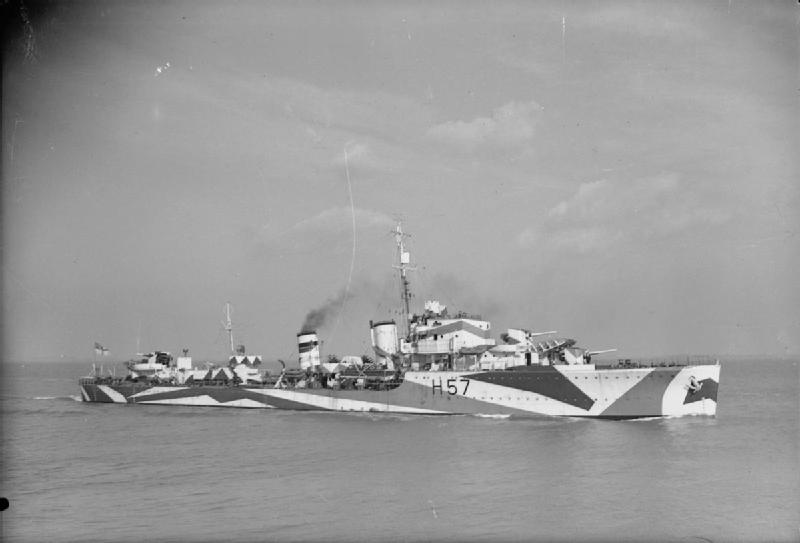
HMS Hesperus was an H-class destroyer originally ordered by the Brazilian Navy as Juruena in the late 1930s. Laid down by John I. Thornycroft and Company at Woolston, Hampshire, on July 6, 1938, she was launched on August 1, 1939, and purchased by the Royal Navy shortly after the outbreak of World War II, being commissioned on January 22, 1940. Initially named HMS Hearty, she was soon renamed Hesperus to avoid confusion with another vessel. Physically, Hesperus displaced approximately 1,350 long tons at standard load and about 1,883 long tons at deep load. She measured 323 feet in overall length, with a beam of 33 feet and a draught of 12 feet 5 inches. Powered by two Parsons geared steam turbines and three Admiralty 3-drum boilers, she could reach a maximum speed of 36 knots, powered by 34,000 shaft horsepower. Her fuel capacity allowed a range of 5,530 nautical miles at 15 knots. The ship's complement consisted of 152 officers and ratings. Armed initially with four 4.7-inch Mk IX guns, two quadruple 0.5-inch Vickers machine guns for anti-aircraft defense, and two twin 21-inch torpedo tubes, Hesperus was fitted with additional depth charges and later modifications included a Hedgehog anti-submarine mortar, Oerlikon 20 mm guns, and radar systems such as Type 271 and Type 286. Her anti-submarine capabilities were enhanced during her service, including the addition of ASDIC and increased depth charge stowage. Hesperus’s service record was marked by active participation in convoy escort and anti-submarine warfare in the Atlantic and Mediterranean. She engaged and sank multiple German U-boats, notably U-208, U-357, U-191, and U-186, often by ramming and deploying depth charges. She sustained damage during her operations but was repaired and converted into an escort destroyer in 1943. Her wartime activities included transporting elements of the Scots Guards during the Norwegian Campaign, escorting Winston Churchill’s battleship to the Atlantic Charter meeting, and later, participating in the repatriation of the Norwegian government in exile. After the war, Hesperus continued to serve in various roles, including escorting surrendered U-boats and transporting the Norwegian government back to Norway. She served as an aircraft target ship until mid-1946 and was scrapped beginning in 1947. Her service exemplifies the vital role of destroyers in convoy escort, anti-submarine warfare, and maritime protection during World War II.
This description has been generated using GPT-4.1-NANO based on the Vessel's wikidata information and then modified by ShipIndex.org staff.