
Adriatic
American steamship
Vessel Wikidata
* This information from Wikidata is available under the Creative Commons Attribution-ShareAlike License
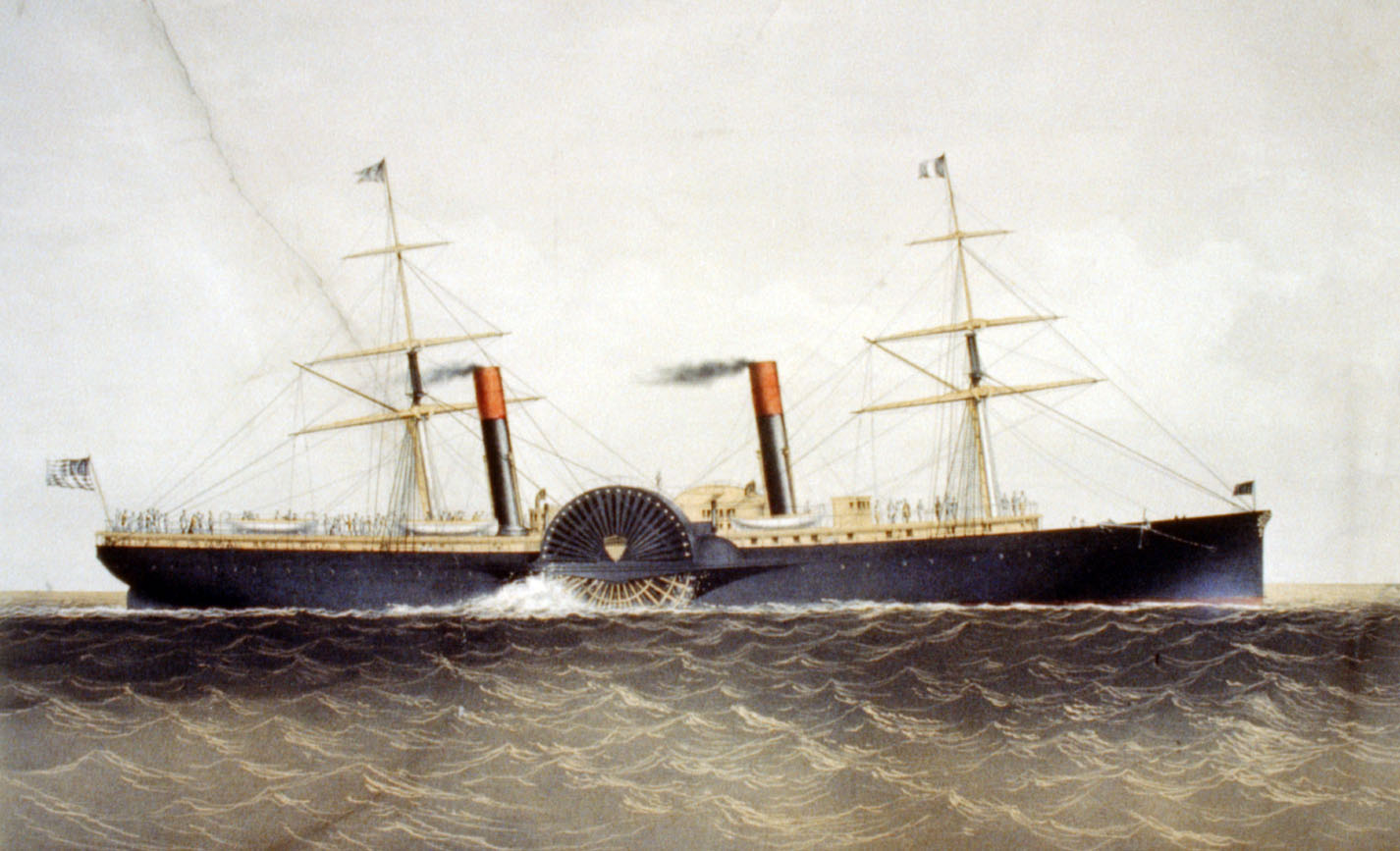
The SS Adriatic, launched in 1856 in New York, was a groundbreaking wooden-hulled, side-wheel steamship and at her time of completion, the largest ship in the world. She measured 354 feet (108 meters) in length with a beam of 50 feet (15 meters) and a depth of hold of 33 feet 2 inches (10.11 meters), displacing approximately 5,233 tons at her design draft of 20 feet (6.1 meters). Her hull was constructed of live and white oak, reinforced with iron strapping 5 inches wide and nearly 1 inch thick, divided into eight watertight compartments for added safety. Propelled by two massive side-mounted paddlewheels, each 40 feet in diameter, Adriatic featured two oscillating steam engines with cylinders 100 inches in diameter and a 12-foot piston stroke. Her machinery, built by the Novelty Iron Works, was one of the largest at the time, powered by eight boilers, and pushed the ship to speeds approaching 18 knots on her trials. She was rigged as a brig with two masts, allowing her to sail if her engines failed. Adriatic’s passenger accommodations were luxurious and varied across decks. The hurricane deck housed officer’s staterooms and skylights illuminating the saloons and machinery spaces. The spar deck contained the grand dining saloon—75 feet long and 28 feet wide—capable of serving 200 passengers, featuring oak paneling, carved figures, large mirrors, and crimson velvet settees. The main deck included the first-class saloon with 130 staterooms, and second-class facilities, while below decks housed cargo, crew quarters, and coal storage for her 1,500-ton capacity. Limited to about 300 first-class and 100 second-class passengers, with a crew of 188, she was intended for luxury trans-Atlantic service. Her maiden voyage in November 1857 was marred by a collision at departure, but she successfully crossed the Atlantic in just over ten days to Liverpool, demonstrating her impressive speed. Despite her technological innovations and grandeur, Adriatic’s commercial career was short-lived. Owned initially by the Collins Line, her high costs and mechanical issues, including problematic steam valves and condensers, hampered her operations. After Collins Line’s bankruptcy, she changed hands multiple times—serving the Galway Line, the British Admiralty, and later the African Steam Ship Company—primarily as a cargo or auxiliary vessel. She was eventually abandoned at the mouth of the Niger River in 1885, serving as a coal hulk before being found infested with shipworms and left to decay, marking the end of a ship that symbolized American maritime ambition and engineering prowess of the 1850s.
This description has been generated using GPT-4.1-NANO based on the Vessel's wikidata information and then modified by ShipIndex.org staff.