
RMS Empress of Britain
1931 ocean liner
Vessel Wikidata
* This information from Wikidata is available under the Creative Commons Attribution-ShareAlike License
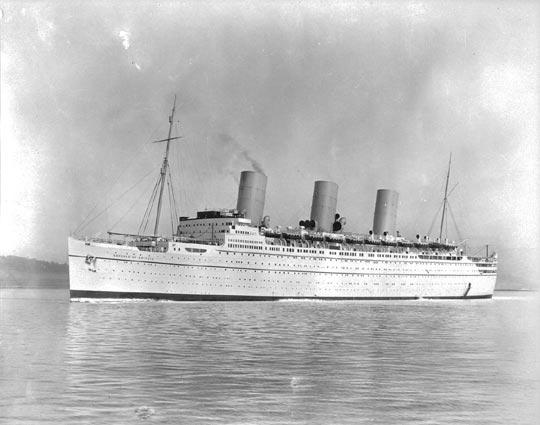
The RMS Empress of Britain was a notable early 20th-century ocean liner constructed between 1928 and 1931 at the John Brown & Company shipyard in Clydebank, Scotland. She was owned by the Canadian Pacific Railway Company and operated by the Canadian Pacific Steamship Company, serving primarily as a trans-Atlantic passenger vessel between the United Kingdom and Canada from 1931 until the outbreak of World War II in 1939. At 42,348 gross register tons (GRT), she was the largest ship in the Canadian Pacific fleet, and during her service, she was renowned as the largest, fastest, and most luxurious vessel operating on the UK-Canada route. The vessel measured approximately 760.8 feet (231.9 meters) in length and was powered by a quadruple-screw propulsion system driven by 12 steam turbines, which supplied steam at 425 pounds per square inch to eight Yarrow boilers and one Johnson boiler—an experimental feature. Her turbines generated a combined power of 12,753 NHP, enabling her to reach speeds of over 25 knots during trials, making her the fastest ship from England to Canada at the time. She featured nine water-tube boilers, and her design included reinforced steel plating at the bow and sides to withstand icy waters off Newfoundland. Her luxurious amenities included multiple decks dedicated to recreation and public entertainment, with decorations by renowned artists, and she was designed to carry 1,195 passengers across three classes. The Empress of Britain was also built to operate year-round as a luxury cruise ship during the winter, accommodating 700 passengers in a fully first-class configuration. Her size and design allowed her to transit the Panama and Suez canals, maintaining versatility for various routes. Notably, she made her maiden voyage on 27 May 1931 from Southampton to Quebec, establishing herself as a symbol of Canadian maritime progress. Her service included trans-Atlantic crossings, world cruises, and visits to Australia, where she was the largest liner to dock at Melbourne in 1938. Her career was interrupted by the onset of World War II, and she was requisitioned as a troop transport in 1939. Her wartime service ended tragically when, on 28 October 1940, she was torpedoed and sunk by the German U-boat U-32 after being bombed by a German bomber. Her sinking marked her as one of the largest liners lost during the war and the largest ship sunk by a U-boat, with suspicions that she was carrying gold shipments at the time. Her wreck now lies upside down at a depth of 500 feet, a subject of maritime history and salvage interest.
This description has been generated using GPT-4.1-NANO based on the Vessel's wikidata information and then modified by ShipIndex.org staff.