
HMS King George V
1939 King George V-class battleship
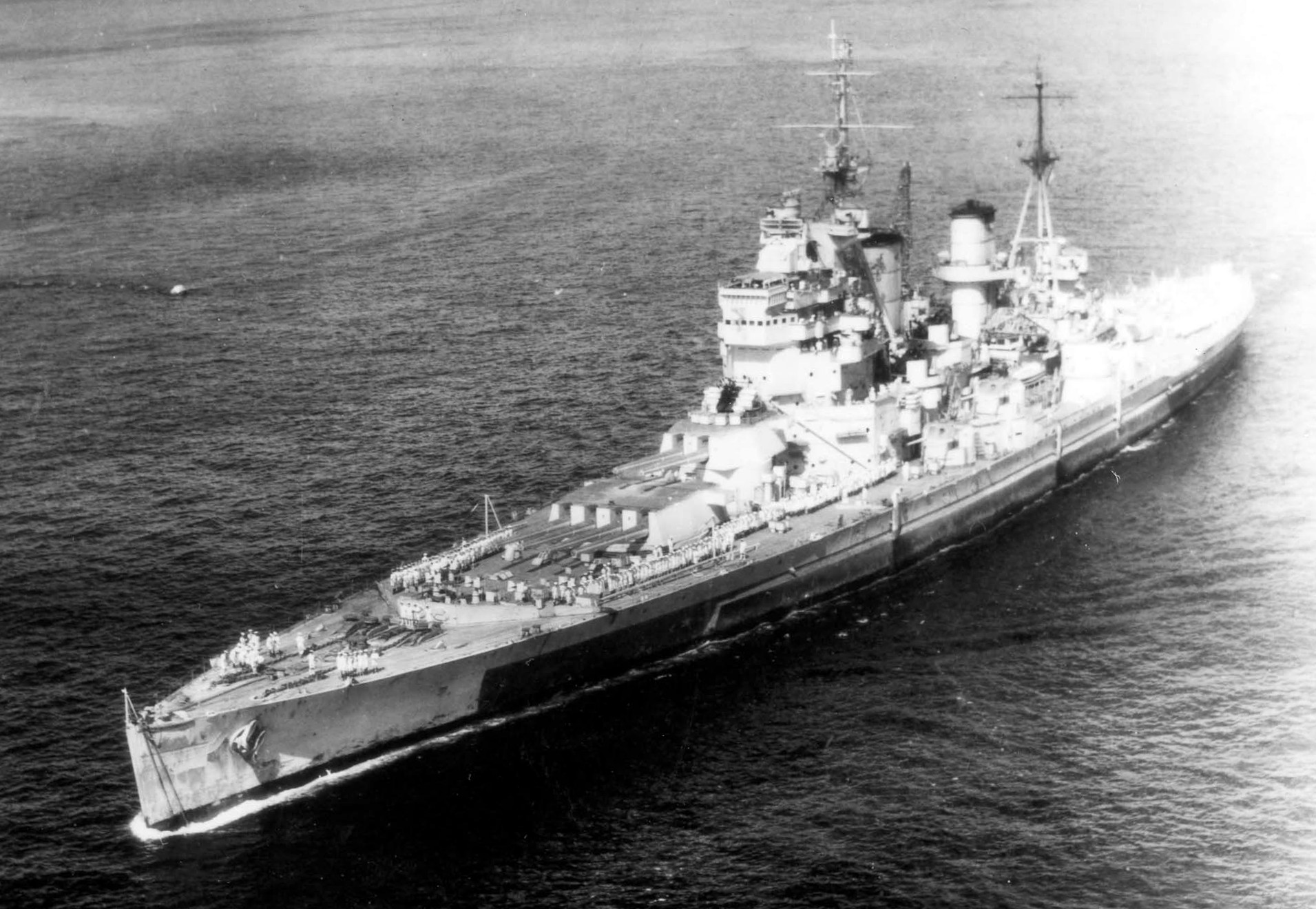
Vessel Wikidata
* This information from Wikidata is available under the Creative Commons Attribution-ShareAlike License
HMS King George V (pennant number 41) was the lead ship of the Royal Navy’s King George V-class battleships, constructed by Vickers-Armstrong at Walker Naval Yard in Newcastle upon Tyne. Laid down on January 1, 1937, launched on February 21, 1939, and commissioned on December 11, 1940, she measured 745 feet (227 meters) in length, with a beam of 112 feet (34 meters) and a draught of 34 feet (10 meters). Her displacement was approximately 38,031 tons at normal load, which increased to over 42,000 tons at full load after wartime modifications. The ship’s propulsion system comprised eight Admiralty boilers producing more than 100,000 shaft horsepower, driving four Parsons geared turbines, which enabled her to reach speeds of up to 28 knots. Armament was a key feature of HMS King George V, with her main battery consisting of ten 14-inch (356 mm) guns arranged in one twin turret forward and two quadruple turrets aft, capable of elevating 40 degrees. Her secondary armament included sixteen 5.25-inch guns in eight twin mounts, and anti-aircraft defenses featuring quadruple machine gun mounts and later upgraded pom-poms and Unrotated Projectile mounts. Her fire control systems included the Admiralty Fire Control Table Mark IX and the Mk IV Pom-Pom Director, pioneering gyroscopic target tracking. Throughout her service, HMS King George V participated in key naval operations during World War II. She was involved in the hunt for the German battleship Bismarck, providing flagship command during the engagement that led to Bismarck’s sinking. She also supported Operation Husky, bombarding Sicilian targets and escorting surrendered Italian ships. Her Pacific service included operations against Japanese forces, participating in bombardments and supporting the Allied advance into Japan’s home islands. She served as flagship of the Home Fleet from April 1941 and later as a training battleship before being retired in 1950. Ultimately, she was the first large warship to be preserved in reserve before being scrapped in 1958, marking a significant transition in naval vessel preservation.
This description has been generated using GPT-4.1-NANO based on the Vessel's wikidata information and then modified by ShipIndex.org staff.