
USAT McClellan
United States Army transport ship
Vessel Wikidata
* This information from Wikidata is available under the Creative Commons Attribution-ShareAlike License
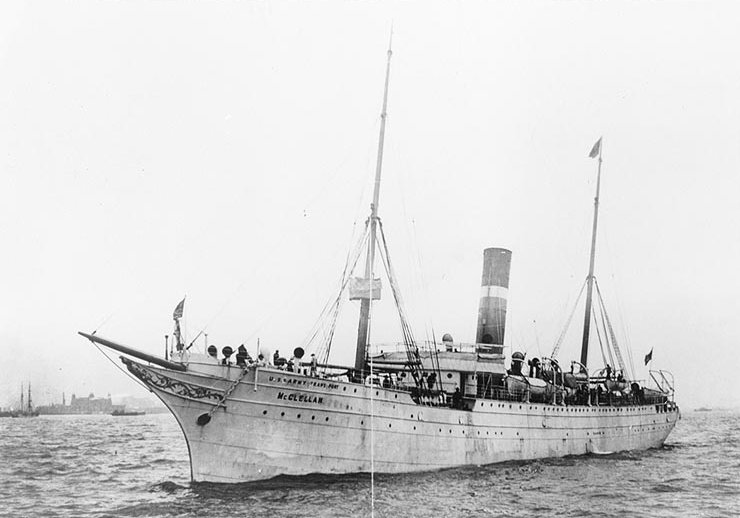
USAT McClellan was a versatile transport vessel with a rich operational history spanning over three decades. Originally built as SS Port Victor in 1885 by Andrew Leslie & Co. in Newcastle-on-Tyne, she was a steel-hulled passenger-cargo screw steamer. Weighing approximately 2,793 tons (1,828 tons gross), Port Victor featured two decks, six watertight bulkheads, and a distinctive clipper bow, powered by a 400 IHP triple expansion steam engine with cylinders measuring 27, 42, and 70 inches, and a 48-inch stroke. Her design included two masts, allowing her to be barque-rigged, and she was recognized for her fine proportions and handsome appearance. Initially operating between London and Australian ports such as Melbourne, Sydney, Hobart, and Darwin, Port Victor also served in the broader Pacific and Far Eastern regions, including New Zealand, Singapore, Hong Kong, and Batavia. Her service was marked by notable events such as running aground off Restoration Island in 1889 and surviving a severe gale in 1887 that damaged her upper structures. She was also involved in transporting passengers, livestock, and cargo, including wool, emus, and emigrants, reflecting her role in trade and migration. Around 1891, she was converted into an early refrigerated ship, allowing her to carry fresh produce like apples and pears from Tasmania to Britain. Her design was innovative for the time, as she could carry both cargo and passengers, including officers and their families. By 1897, she had shifted to Caribbean service, carrying Jamaican fruit to London. After her purchase by the U.S. government in 1898 for use in the Spanish–American War, she was renamed USAT McClellan. She served as a troop and supply transport, supporting U.S. military occupations in Cuba, Puerto Rico, and later the Philippines. Her duties included transporting troops, officials, and supplies, as well as returning the remains of soldiers. She participated in significant events such as relief efforts following hurricanes in Puerto Rico and the grand naval parade in New York in 1901. In 1914, McClellan was converted into a refrigerated cargo ship for the U.S. Army, capable of transporting frozen meat and produce, vital for supplying troops in the Gulf of Mexico and the Philippines. She also participated in the occupation of Veracruz in 1914, transporting troops and equipment. During World War I, although authorized to be taken over by the Navy, she remained with the Army. After her military service, McClellan was sold in 1919 to a Belgian company and re-entered commercial service as SS Hastier. Her career ended with a fire in 1920 that sank her in Antwerp, though she was later raised and ultimately scrapped in 1922. Throughout her active years, USAT McClellan exemplified adaptability and played a significant role in both commercial and military maritime operations.
This description has been generated using GPT-4.1-NANO based on the Vessel's wikidata information and then modified by ShipIndex.org staff.