
CSS Nashville
Confederate ironclad
Vessel Wikidata
* This information from Wikidata is available under the Creative Commons Attribution-ShareAlike License
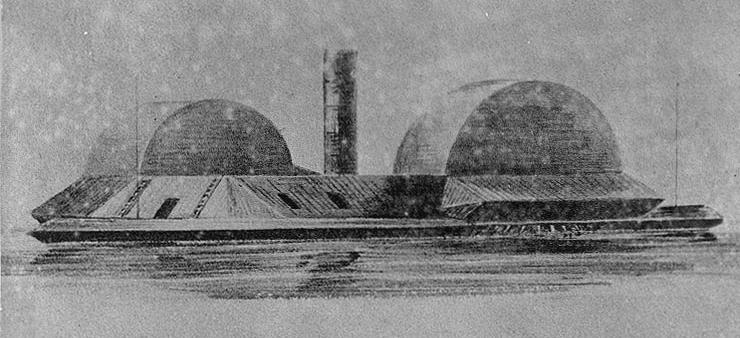
CSS Nashville was a formidable side-wheel Nashville-class ironclad built by the Confederates during the late stages of the American Civil War. Measuring 271 feet (82.6 meters) in length overall and with a beam of 62 feet 6 inches (19.1 meters), she was designed as a heavily armored warship intended for riverine and coastal operations. Her draft was relatively shallow at 10 feet 9 inches (3.3 meters), allowing navigation in shallow waters. The vessel was powered by two steam engines with a 9-inch bore and a 36-inch stroke, which drove her side wheels, providing her with significant mobility for a vessel of her class. Nashville was constructed in Montgomery, Alabama, primarily due to the availability of riverboat engines, and was launched in mid-1863. She was subsequently taken to Mobile, Alabama, for completion in 1864. Her armor incorporated elements from the CSS Baltic, and she was armed with three 7-inch Brooke rifles alongside a 24-pounder howitzer, making her a formidable opponent in combat. Throughout her service, Nashville participated in various engagements, including defending Spanish Fort, Alabama, on 27 March 1865, and shelling Federal troops near Fort Blakeley on 2 April 1865. She supported Confederate efforts until the surrender of Mobile in April 1865. She was among the vessels formally surrendered at Nanna Hubba Bluff in May 1865. Despite her impressive armor, she was only partially completed, with triple 2-inch plating forward and around her pilot house, but only a single layer aft. Post-surrender, doubts about her structural integrity emerged; Rear Admiral Henry K. Thatcher noted she was hogged and too weak to withstand the stresses of open-sea conditions. Following her surrender, Nashville was laid up until she was sold for scrap in November 1867 in New Orleans, her armor having been stripped for reuse. Her construction and limited operational history reflect the Confederate effort to develop a robust ironclad fleet late in the Civil War, though her incomplete state and structural issues underscored the challenges faced by the Confederate war effort.
This description has been generated using GPT-4.1-NANO based on the Vessel's wikidata information and then modified by ShipIndex.org staff.