
Japanese battleship Nagato
1919 Nagato-class battleship
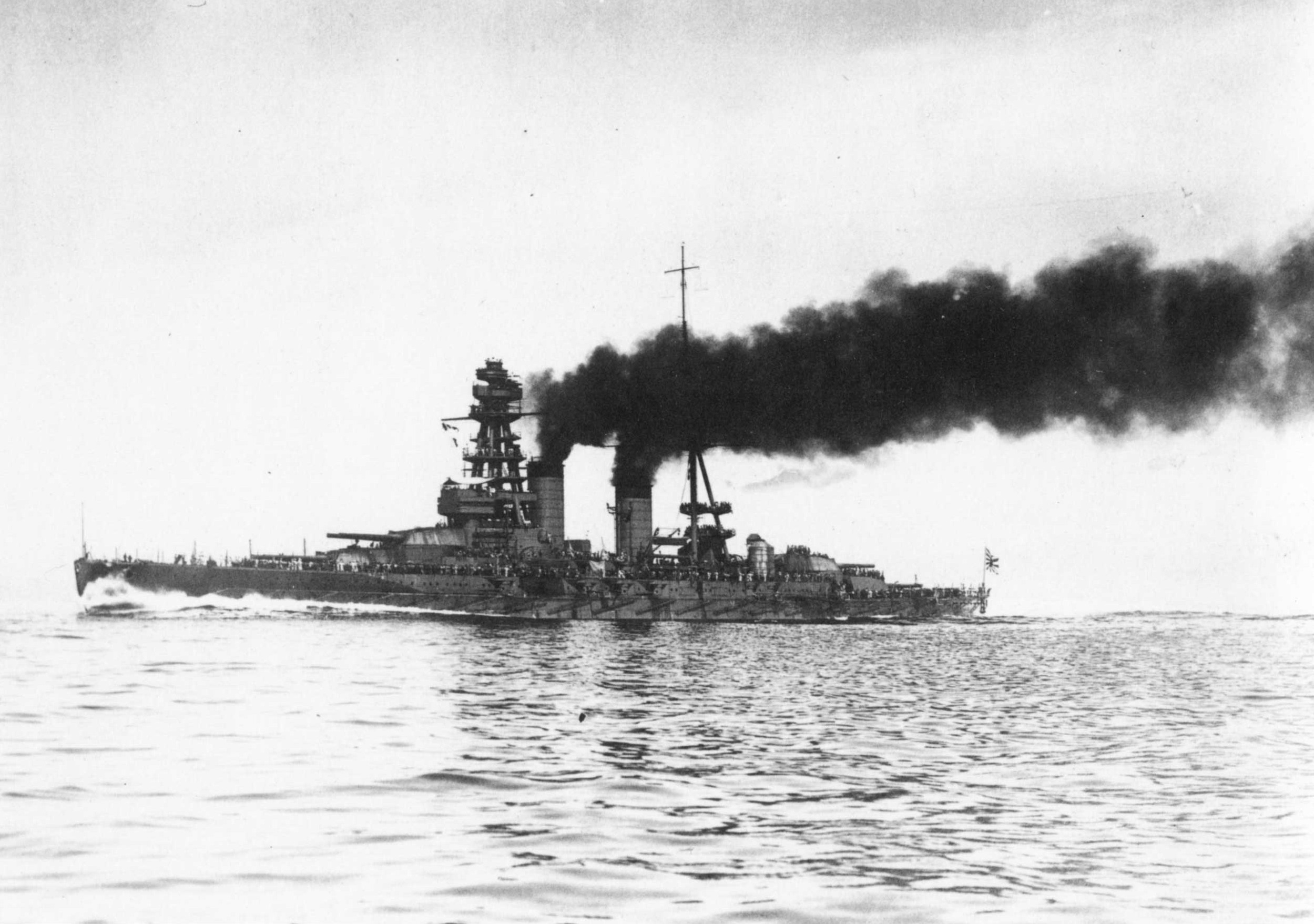
Vessel Wikidata
* This information from Wikidata is available under the Creative Commons Attribution-ShareAlike License
The Japanese battleship Nagato was a notable super-dreadnought constructed for the Imperial Japanese Navy, launched in 1919 and completed in 1920. She measured overall 215.8 meters (708 feet) and between perpendiculars 201.17 meters (660 feet), with a beam of 29.02 meters (95 feet 3 inches) and a draft of 9.08 meters (29 feet 9 inches). Her displacement was 32,720 metric tons at standard load, increasing to 39,116 tons at full load, with her full length later extended to 224.94 meters (738 feet) following her 1934–1936 modernization. Her main armament consisted of eight 41-centimeter (16-inch) guns mounted in four twin turrets in superfiring pairs fore and aft, with the turrets upgraded during reconstruction for increased range. The secondary armament included twenty 14-centimeter guns, later replaced or supplemented by additional dual-purpose guns and numerous light AA weapons, notably the Type 96 25 mm guns, which proved largely ineffective during the war. She was also equipped with eight 53.3-centimeter torpedo tubes. Nagato's armor was formidable, with a waterline belt up to 305 mm (12 inches) thick, and heavily armored turrets with face plates of 460 mm (18.1 inches) after her reconstruction. Her deck armor ranged from 69 to 75 mm, and her turrets and barbettes had armor up to 305 mm. During her modernization, her armor was reinforced, and her superstructure was rebuilt into a pagoda mast style. Propulsion was provided by four geared steam turbines producing 80,000 shaft horsepower, driving four propellers, with her boilers replaced by oil-fired Kampon units during her reconstruction. She could reach speeds exceeding her original 26.5 knots, with sea trials recording 26.7 knots. Her service history includes participation in the Second Sino-Japanese War, where she served as flagship during the attack on Pearl Harbor, though she did not directly partake in the initial assault. She engaged in various Pacific War operations, including the Battle of Midway (without combat), and later saw action at the Battle of the Philippine Sea and Leyte Gulf, where she was lightly damaged. As the war progressed, she was converted into a floating anti-aircraft platform and was the only Japanese battleship to survive World War II. Post-war, Nagato was used as a target in nuclear tests during Operation Crossroads in 1946. She survived the first test but capsized and sank during the second, now resting upside down at a depth of 33.5 meters (110 feet). Today, her wreck is a popular scuba diving site, recognized as one of the top ten wreck diving locations worldwide.
This description has been generated using GPT-4.1-NANO based on the Vessel's wikidata information and then modified by ShipIndex.org staff.