
HMS Birmingham
1936 Southampton-class light cruiser
Vessel Wikidata
* This information from Wikidata is available under the Creative Commons Attribution-ShareAlike License
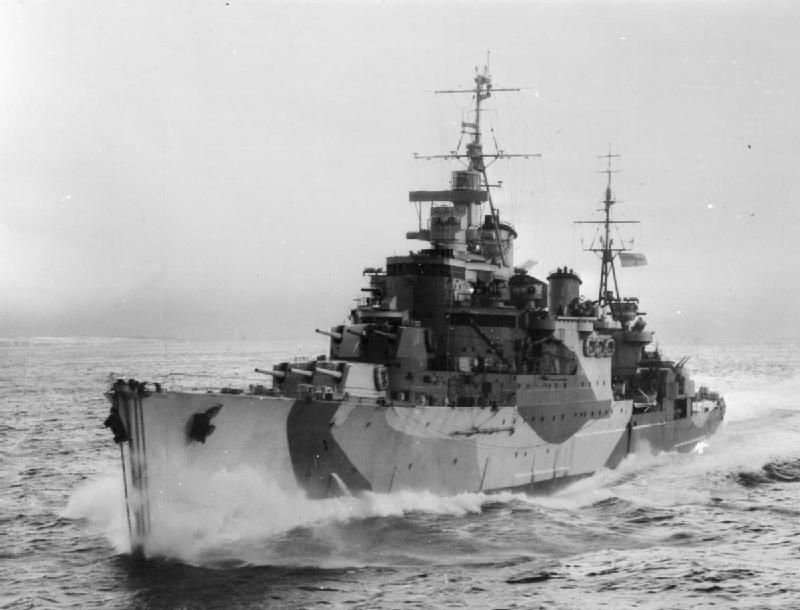
HMS Birmingham was a Town-class light cruiser, part of the first group of five ships in this class. Constructed for the Royal Navy, she was equipped with a main armament of nine 6-inch guns arranged in three turrets, complemented by sixteen 4-inch guns and eighteen Bofors 40 mm anti-aircraft guns after her later refits. Although specific displacement figures are not provided in the source, her robust armament and modifications indicate a vessel designed for versatility and engagement in various combat scenarios. Commissioned prior to World War II, Birmingham initially served on the China Station with the 5th Cruiser Squadron from January 1938. At the outbreak of war, she was refitted in Malta and subsequently joined the Home Fleet, serving in the 18th Cruiser Squadron. Her early wartime duties included patrolling off Norway to prevent German fishing activities, escorting troop convoys, and engaging German vessels such as sinking the patrol boat Schiff 37 in April 1940. She played a role in evacuating troops from Åndalsnes and participated in convoy escort missions around the Cape of Good Hope. In 1941, Birmingham was involved in the hunt for the German battleship Bismarck but did not engage directly. She escorted convoy WS-9A to South Africa, where she received upgrades, including new radar systems and anti-aircraft weapons. She later joined the Eastern Fleet and was reassigned to the Mediterranean, participating in the critical Malta convoy operations "Harpoon" and "Vigorous." During this period, she was damaged by near misses from German and Italian aircraft. Her service extended to operations in Madagascar and convoy escort missions. In 1943, Birmingham was torpedoed by U-407 off Cyrenaica, suffering severe damage including the loss of her bow and the death of around seventy men. She was repaired in the US and received significant armament updates, including replacing her 'X' turret with Bofors guns. Post-repair, she participated in the Baltic occupation at the end of the war, and later served in the South Atlantic, East Indies, and Far East Fleets, including involvement in the Korean War. Her service life concluded in 1959 when she was decommissioned and scrapped the following year. Throughout her career, HMS Birmingham was notable for her active engagement across multiple theatres, her adaptability through multiple refits, and her participation in key naval operations during World War II and beyond, marking her as a significant vessel in mid-20th-century maritime history.
This description has been generated using GPT-4.1-NANO based on the Vessel's wikidata information and then modified by ShipIndex.org staff.