
USS Vixen
ship
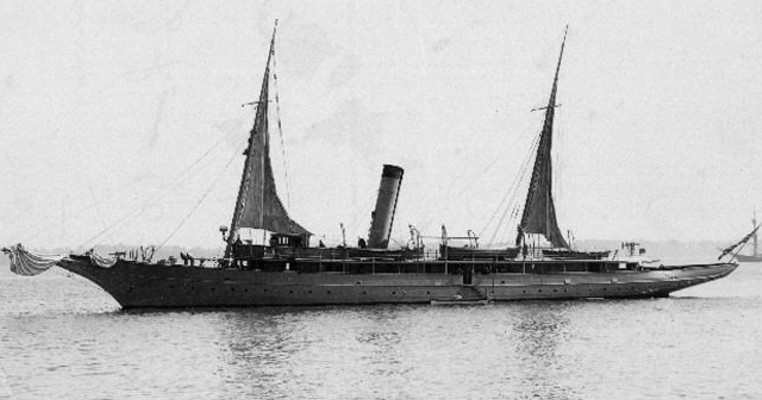
Vessel Wikidata
* This information from Wikidata is available under the Creative Commons Attribution-ShareAlike License
The USS Vixen (PY-4) was a steel-hulled, schooner-rigged steam yacht built at Crescent Shipyard in Elizabethport, New Jersey, by Lewis Nixon as hull number 16 for Philadelphia financier Peter Arrell Brown Widener. Launched on March 4, 1896, and delivered in June of that year, the vessel featured two coal-heated boilers powering a triple expansion steam engine that drove a single shaft. Her design included a coal capacity of 210 tons, granting her an impressive range of approximately 6,000 miles, supported by five boats, including a steam launch, and equipped with up to fifty 16-candlepower incandescent lights and a searchlight. Purchased by the U.S. Navy on April 9, 1898, for $150,000, she was renamed Vixen and commissioned shortly thereafter at the Philadelphia Navy Yard. She was assigned to the North Atlantic Station and sailed to Cuban waters during the Spanish–American War, arriving off Cuba on May 16, 1898. During the conflict, Vixen performed various duties such as blockade, patrol, mail and flag of truce transport, prisoner ferrying, and reconnaissance. Notably, she carried Theodore Roosevelt, then a colonel of the Rough Riders, and other distinguished personnel, including Midshipman Thomas C. Hart and Arthur MacArthur III. Vixen participated in the bombardment of Santiago and the Battle of Santiago in June and July 1898. During the battle, she was present near Morro Castle and narrowly escaped damage when Spanish vessels, including the armored cruiser Vizcaya, sortieed from the harbor. She engaged Vizcaya later in the day as she was battered and grounded, contributing to the American efforts against the Spanish fleet. Following the war, Vixen returned to the U.S., operating off Puerto Rico and along the East Coast for the next several years, conducting surveys, carrying mail, and serving as a tender and station ship, notably at Guantanamo Bay. Decommissioned in 1906, she was loaned to the New Jersey Naval Militia until World War I, when she was recommissioned to patrol the eastern seaboard and serve as a station ship at St. Thomas in the Virgin Islands. Reclassified as PY-4 in 1920, she was decommissioned in 1922, struck from the Navy list in 1923, and sold later that year. Her service highlights her versatility and significance in U.S. naval history, especially during the Spanish–American War and World War I.
This description has been generated using GPT-4.1-NANO based on the Vessel's wikidata information and then modified by ShipIndex.org staff.