
SS Leonardo da Vinci
Ocean liner built in 1960
Vessel Wikidata
* This information from Wikidata is available under the Creative Commons Attribution-ShareAlike License
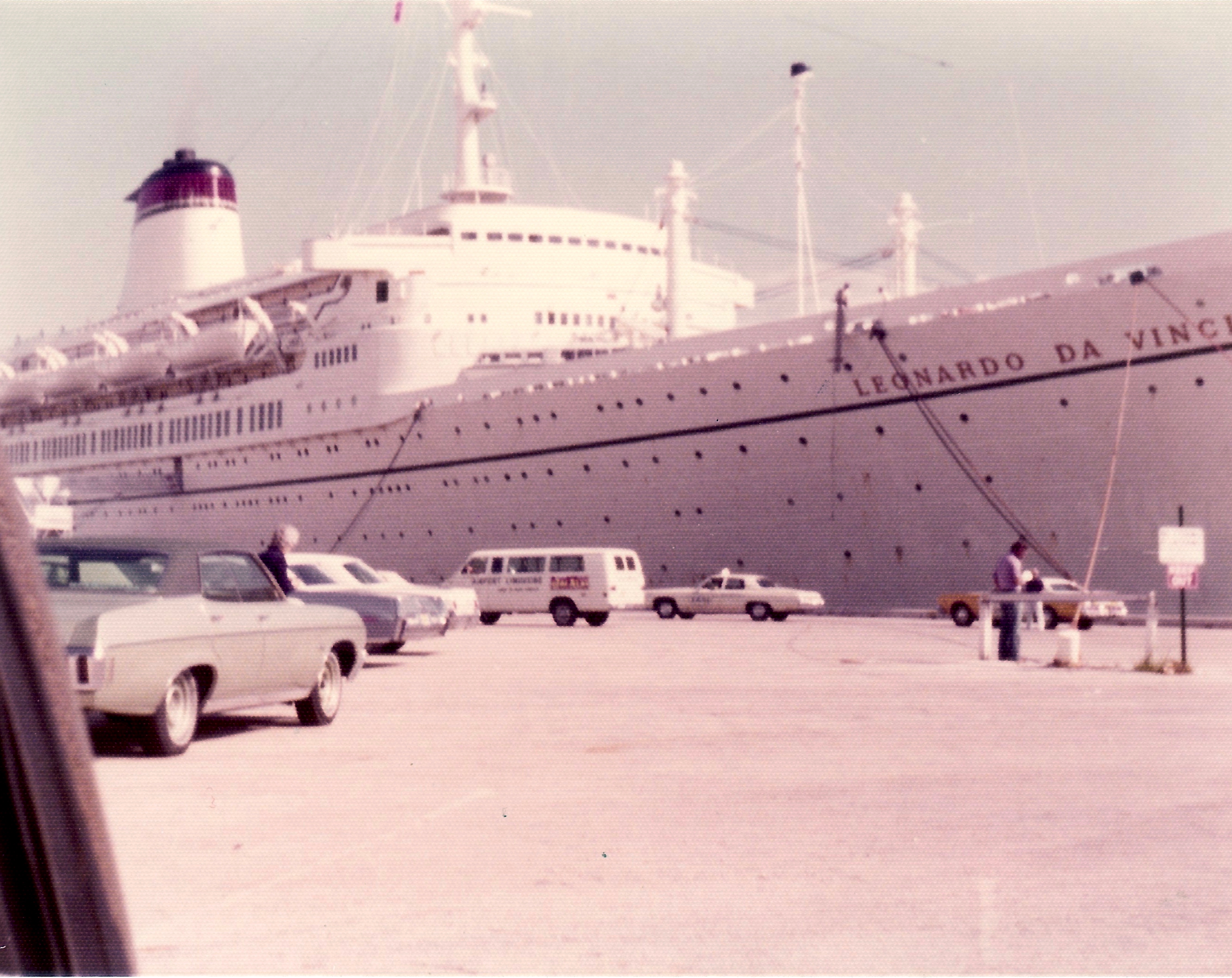
The SS Leonardo da Vinci was an Italian ocean liner constructed in 1960 by Ansaldo Shipyards in Genoa, designed as a modern replacement for the lost SS Andrea Doria. She measured approximately 30,000 gross register tons and incorporated numerous technological innovations, including provisions for future conversion to nuclear power. The vessel featured a sleek, balanced exterior design similar to her sister ships, with a black hull and a white decorative band initially, later changed in 1966 to a white hull with a green band, reflecting contemporary Italian Line livery updates. Her length exceeded that of her predecessors by about 19 meters, and she boasted a larger superstructure with a distinctive funnel and a spacious lido area, as she lacked freight handling equipment at the stern. Constructed with safety enhancements inspired by the Andrea Doria disaster, the Leonardo da Vinci was equipped with extended watertight bulkheads, motorized lifeboats capable of launching against a 25-degree list, and engine compartment separation, ensuring improved survivability. She was launched on December 7, 1958, and delivered in early 1960, with her maiden voyage departing from Genoa to New York on June 30, 1960. Despite her advanced safety features, she proved somewhat unstable in rough weather, necessitating the addition of 3,000 metric tons of iron ballast to improve stability, which increased her weight and fuel consumption. Initially used in transatlantic service alongside ships like SS Cristoforo Colombo, her role shifted post-1965 to primarily cruising, especially around the Mediterranean, the Caribbean, and South America. She was notable for a 41-day cruise to Hawaii via the Panama Canal in 1970. By the mid-1970s, as jet aircraft competition intensified, her transatlantic service was phased out, and she was laid up in 1976. Briefly reactivated for cruising under Italia Crociere in 1977–78, she was laid up again in 1978, eventually succumbing to a fire in 1980. The ship capsized and was scrapped in 1982. Her design and operational history reflect the transitional era of post-war passenger shipping, marked by technological ambition and changing travel preferences.
This description has been generated using GPT-4.1-NANO based on the Vessel's wikidata information and then modified by ShipIndex.org staff.