
Marco Polo
cruise ship launched in 1964
Vessel Wikidata
* This information from Wikidata is available under the Creative Commons Attribution-ShareAlike License
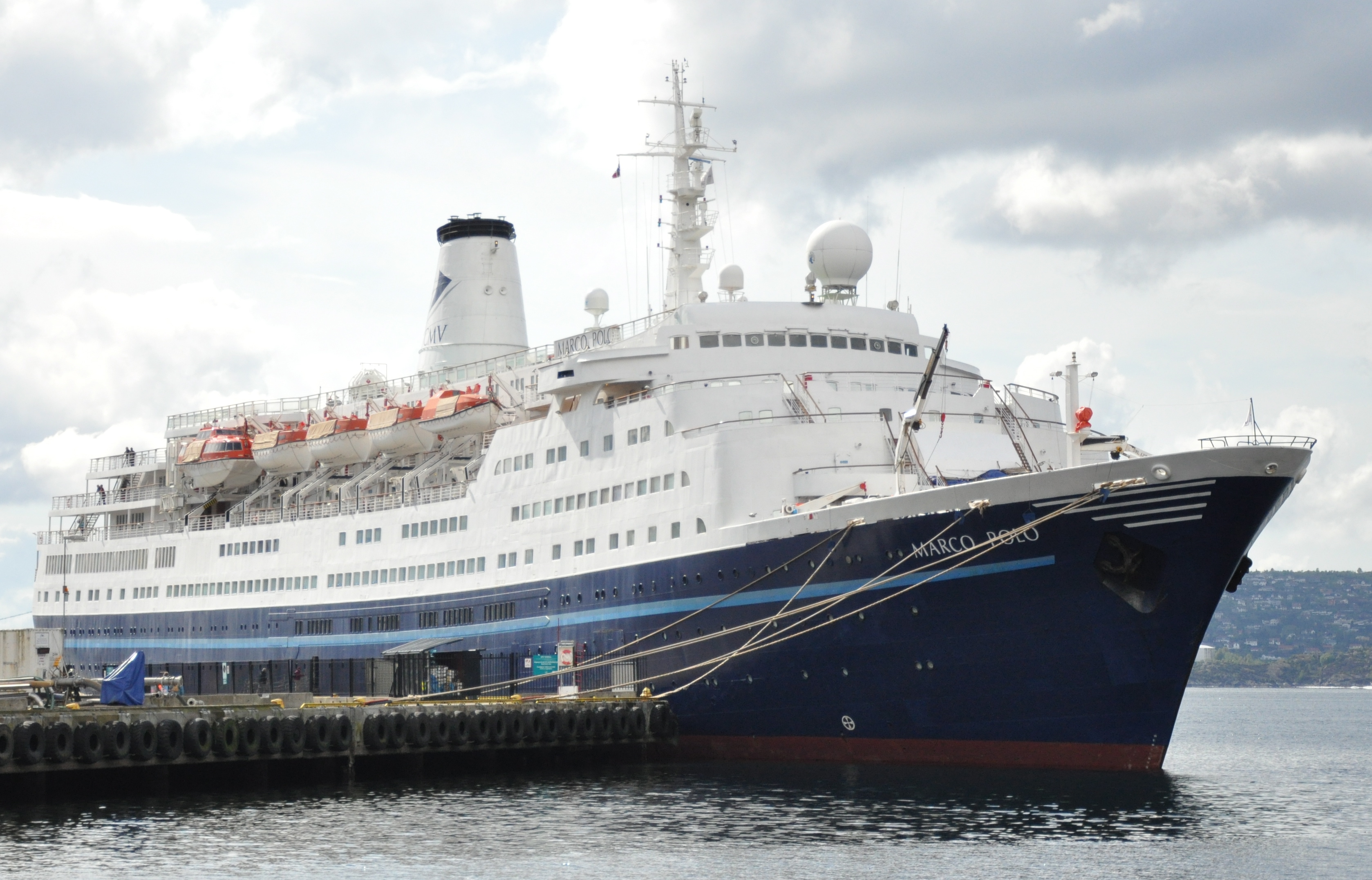
The MS Marco Polo was originally constructed in 1965 as the ocean liner Aleksandr Pushkin by Mathias-Thesen-Werft in Wismar, East Germany. As part of the Ivan Franko class, she was designed with notable features including cabins for up to six passengers, three taps in bathrooms (hot, cold, and sea water), and all outside accommodation for both passengers and crew. Her hull was built with extra strength and stability to enable navigation through broken ice, and she was equipped with large provision and storage areas, allowing a cruising range exceeding 10,000 nautical miles. The vessel could carry between 650 and 766 passengers across two classes, with additional provisions for 500 cabinless passengers. Passenger accommodations included a variety of public facilities such as multiple restaurants, cafes, a cinema, a music saloon, a library, shops, and swimming pools with a sliding glass roof, reflecting her forward-looking design. Over her service life, Aleksandr Pushkin underwent significant modifications, including enlargements of the superstructure and installation of stabilizers. Initially serving the Soviet Baltic Shipping Company, she operated routes such as Leningrad to Montreal, Helsinki, Copenhagen, London, and cruises to Caribbean destinations. From 1979, she was chartered to Transocean Tours in West Germany, and later, in the 1980s, she was transferred to the Far Eastern Shipping Company and used for cruising from Europe to Australia. In 1991, she was sold to Orient Lines and renamed Marco Polo, undergoing a major refit in Greece that included engine reconditioning, external extensions, interior reconstruction, and the addition of stabilizers, at an estimated cost of up to $60 million. As Marco Polo, she became a versatile cruise ship traversing global routes, including Southeast Asia, Africa, and Antarctica. She was the last surviving Ivan Franko-class vessel by the early 2000s. In 2008, she was sold to the Greek-based Global Maritime Group and operated by Transocean Tours, primarily out of the UK and Germany. Her later years included notable incidents such as a norovirus outbreak in 2009, a collision with an uncharted object in 2013, and a freak wave in 2014 that resulted in a passenger death and injuries. She also ran aground in Norway in 2014. Following the financial collapse of Cruise & Maritime Voyages in 2020, she was auctioned and subsequently scrapped in Alang, India, in early 2021. Her long operational history underscores her significance as a versatile and historically notable vessel in maritime and cruise history.
This description has been generated using GPT-4.1-NANO based on the Vessel's wikidata information and then modified by ShipIndex.org staff.