
German cruiser Prinz Eugen
1938 Admiral Hipper-class cruiser
Vessel Wikidata
* This information from Wikidata is available under the Creative Commons Attribution-ShareAlike License
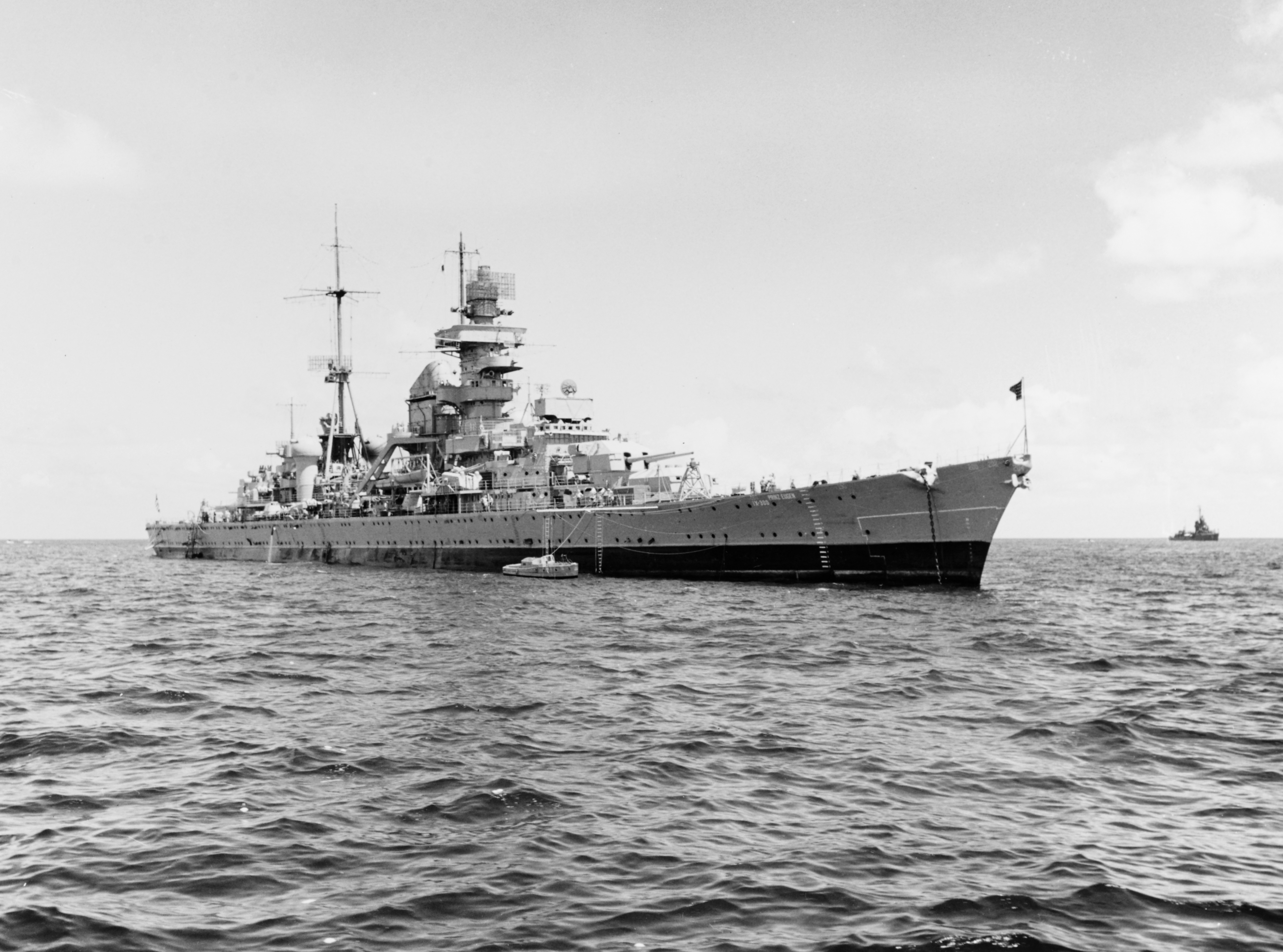
Prinz Eugen was an Admiral Hipper-class heavy cruiser of the Kriegsmarine, constructed by Germaniawerft in Kiel. Laid down in April 1936 and launched in August 1938, she was commissioned in August 1940, shortly after the outbreak of World War II. Despite her nominal displacement being within the 10,000-long-ton limit set by the Anglo-German Naval Agreement, her actual displacement exceeded 16,000 long tons, reflecting her substantial size and armament. Measuring approximately 207.7 meters (681 feet) in length overall, she featured a beam of 21.7 meters (71 feet) and a maximum draft of 7.2 meters (24 feet). Her length increased to about 212.5 meters (697 feet) after replacing her straight bow with a clipper bow, which improved seaworthiness in heavy weather. Powered by three geared steam turbines supplied by twelve oil-fired boilers, Prinz Eugen could reach speeds of up to 32 knots (59 km/h). Her main armament consisted of eight 20.3 cm (8-inch) SK L/60 guns in four twin turrets, with additional anti-aircraft batteries, torpedo launchers, and seaplanes for reconnaissance. Throughout her service, Prinz Eugen participated in several notable operations. She was part of Operation Rheinübung in May 1941, accompanying Bismarck in an Atlantic sortie that resulted in the sinking of the British battlecruiser Hood and the damage of Prince of Wales. She engaged British cruisers and ships during this mission, notably firing upon Hood, which was fatally hit. She later participated in Operation Cerberus, a daring daylight Channel dash back to Germany. In February 1942, she was torpedoed by the British submarine Trident off Norway, causing severe stern damage. She was repaired and later served in various roles, including artillery support on the Eastern Front, and training in the Baltic. In 1944-45, she was actively involved in naval operations defending against Soviet advances, firing thousands of shells in support of German ground forces. After Germany's surrender in May 1945, Prinz Eugen was surrendered to the Allies, transferred to the US Navy, and used in Operation Crossroads nuclear tests at Bikini Atoll. She survived two atomic blasts but was heavily contaminated and eventually capsized and sank in December 1946 off Kwajalein Atoll. A propeller from her is displayed at the Laboe Naval Memorial in Germany, and her wreck remains partially visible today. Her operational history underscores her significance as a formidable and versatile vessel in the Kriegsmarine's wartime fleet.
This description has been generated using GPT-4.1-NANO based on the Vessel's wikidata information and then modified by ShipIndex.org staff.