
HMS Carnarvon
1903 Devonshire-class armoured cruiser
Vessel Wikidata
* This information from Wikidata is available under the Creative Commons Attribution-ShareAlike License
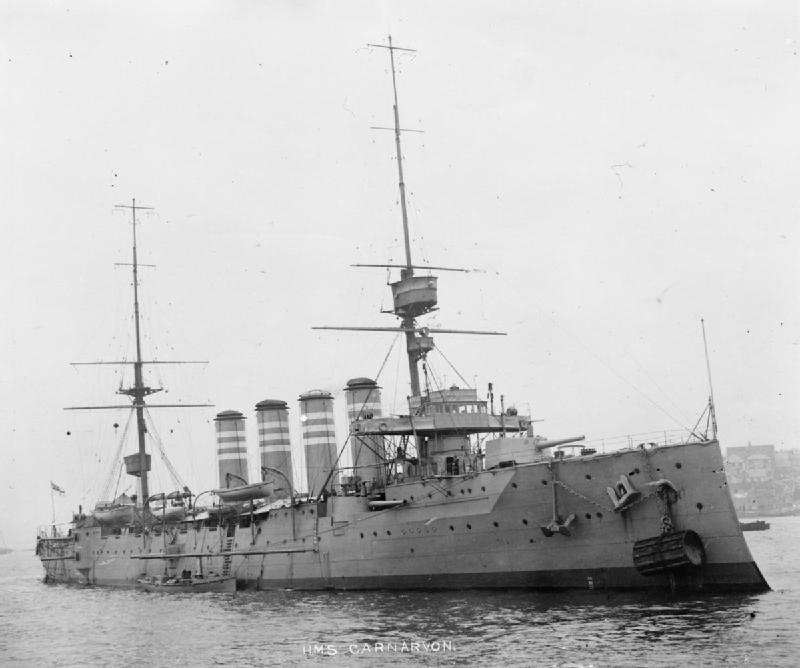
HMS Carnarvon was a Devonshire-class armoured cruiser of the Royal Navy, designed with a displacement of approximately 10,850 long tons (11,020 tonnes). She measured 473 feet 6 inches (144.3 meters) in overall length, with a beam of 68 feet 6 inches (20.9 meters) and a deep draught of 24 feet (7.3 meters). Her propulsion system comprised two 4-cylinder triple-expansion steam engines, delivering a total of 21,000 indicated horsepower, which enabled a maximum speed of 22 knots (41 km/h). The ship was powered by seventeen Niclausse and six cylindrical boilers, carrying up to 1,033 long tons (1,050 tonnes) of coal, and had a crew complement of 610 officers and ratings. Armament included four 7.5-inch (191 mm) BL Mk I guns in single turrets fore and aft, capable of firing shells weighing 200 pounds (91 kg) to a range of approximately 13,800 yards (12,600 meters). Her secondary armament featured six 6-inch (152 mm) BL Mk VII guns in casemates amidships, with four mounted on the main deck for calm weather operations, and a battery of eighteen 3-pounder Hotchkiss guns along with two submerged 18-inch torpedo tubes. Notably, during the war, her main deck six-inch guns were repositioned to the upper deck with added gun shields, and her casemates were plated over to improve seakeeping. Carnarvon's armor comprised a waterline belt ranging from two to six inches thick, with five-inch (127 mm) thick gun turret armor, six-inch thick barbettes, a protective deck of 0.75–2 inches (19–51 mm), and a conning tower with twelve inches (305 mm) of armor. Laid down in October 1902 by William Beardmore & Company at Dalmuir and launched in October 1903, she was completed in May 1905. Her service included assignments with the Mediterranean Fleet, Atlantic Fleet, and reserve fleets. At the outbreak of World War I, she was active in hunting German commerce raiders, notably capturing the SS Professor Woermann and participating in the Battle of the Falklands, where she engaged German cruisers, including Gneisenau and Scharnhorst. After the battle, she was involved in the search for the German light cruiser Dresden and was damaged upon striking a coral reef in 1915, requiring repairs in Rio de Janeiro and Montreal. Following repairs, Carnarvon served on the North America and West Indies Station, protecting Allied shipping until the war's end. She later became a cadet training ship from 1919 until her sale for scrap in 1921, when she was dismantled in Germany. Her operational history highlights her role in key naval engagements and maritime patrols during the early 20th century and World War I.
This description has been generated using GPT-4.1-NANO based on the Vessel's wikidata information and then modified by ShipIndex.org staff.