
HMS Scylla
1940 Dido-class light cruiser
Vessel Wikidata
* This information from Wikidata is available under the Creative Commons Attribution-ShareAlike License
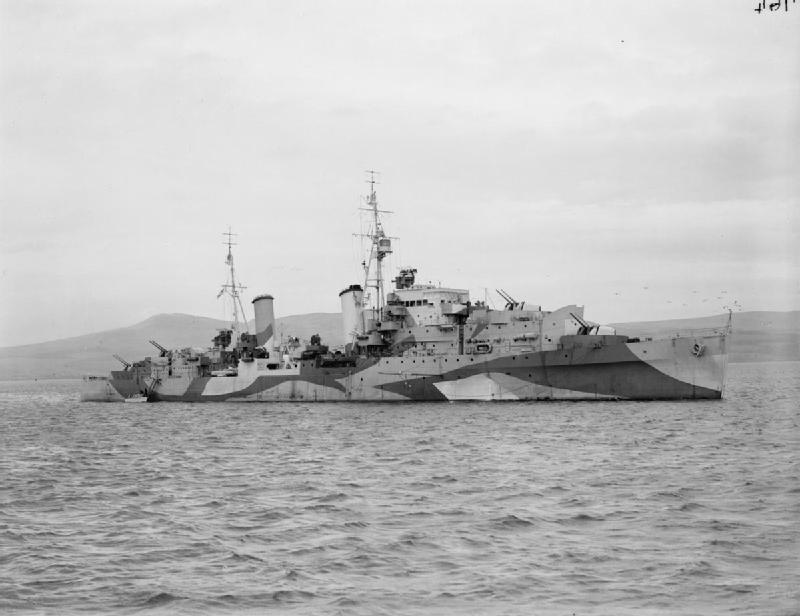
HMS Scylla was a Dido-class cruiser of the Royal Navy, constructed by Scotts Shipbuilding and Engineering Company in Greenock, Scotland. Her keel was laid on 19 April 1939, and she was launched on 24 July 1940, commissioning into service on 12 June 1942. Designed to serve primarily as an escort vessel, she was armed with four twin QF 4.5-inch Mk.III guns in UD MK III mountings, a modification from her original intended armament due to a shortage of QF 5.25-inch gun mountings. The forward superstructure was extensively modified to accommodate these guns and to enhance crew spaces, earning her the nickname 'toothless terrors'—a testament to her formidable anti-aircraft capabilities despite the lighter armament compared to sister ships. Throughout her service in World War II, HMS Scylla played a vital role in escorting Arctic convoys, notably serving as the flagship of Rear Admiral Robert Burnett during the Battle for Convoy PQ 18 in September 1942. She was also equipped with signals intelligence teams, contributing to operations such as the collection of signals from the Kola Peninsula. In late 1942, she participated in Operation Torch, supporting landings in North Africa as part of Force "O" with the Eastern Task Force. Notably, on 31 December 1942, she successfully intercepted and sank the German blockade runner Rhakotis after being directed to her by a RAF Coastal Command aircraft, with F/O Arthur Hodgson receiving the DFC for his role. In 1943, HMS Scylla continued convoy escort duties, including stopping the Irish schooner Mary B Mitchell in the Bay of Biscay. She supported the Salerno landings in September 1943 and later served as an Escort Carrier Flagship, equipped with an Action Information Organisation (AIO) room for radar and intercept coordination. She was the designated flagship for Vice Admiral Philip Vian during the Normandy landings, serving off the coast of France to oversee naval and shipping movements. Her service concluded tragically when she was badly damaged by a mine on 23 June 1944, which led to her being written off. Although towed to Portsmouth, she was not disposed of until 1950, after being used as a target. HMS Scylla was finally broken up at Thos. W. Ward in Barrow-in-Furness, arriving there on 4 May 1950. Her wartime service exemplifies her role as a versatile and vital escort cruiser contributing significantly to Allied naval operations during WWII.
This description has been generated using GPT-4.1-NANO based on the Vessel's wikidata information and then modified by ShipIndex.org staff.