
HMS Wolverine
1919 V and W-class destroyer
Vessel Wikidata
* This information from Wikidata is available under the Creative Commons Attribution-ShareAlike License
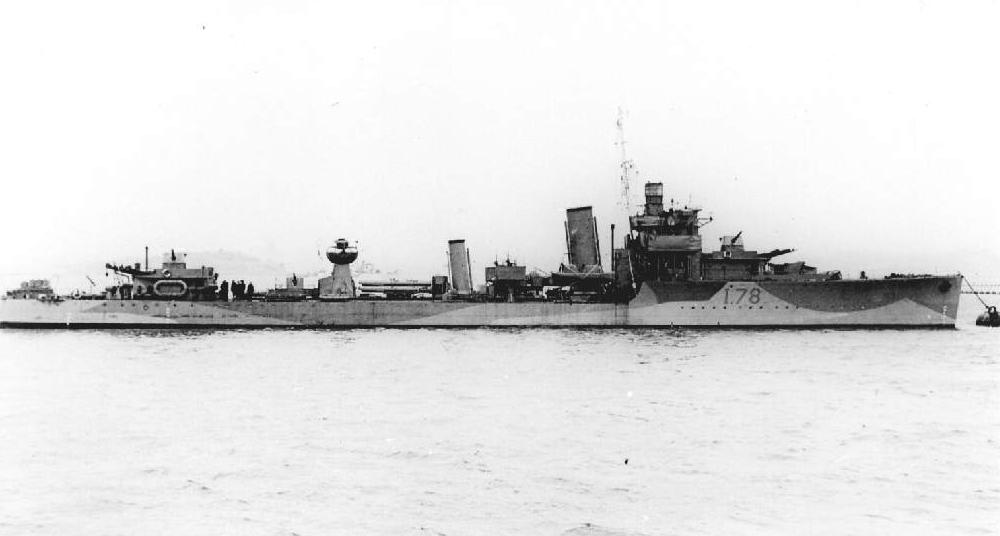
HMS Wolverine (D78) was an Admiralty modified W-class destroyer constructed for the Royal Navy, representing a significant design of the post-World War I era. Laid down on 8 October 1918 at James Samuel White & Co. Ltd. in Cowes, Isle of Wight, she was launched on 17 July 1919. The vessel measured 312 feet (95 meters) in overall length, with a beam of 29.5 feet (9 meters) and a mean draught of 9 feet (2.7 meters), which increased to 11.25 feet (3.43 meters) at full load. Her displacement was 1,140 tons standard, reaching up to 1,550 tons at full load. Propelled by three White-Foster water-tube boilers powering Parsons geared steam turbines, Wolverine developed 27,000 shaft horsepower, allowing her to reach a maximum speed of 34 knots (63 km/h). Her fuel capacity of 320 to 370 tons of oil supported a range of approximately 3,500 nautical miles at 15 knots, or 900 nautical miles at 32 knots. Her armament comprised four BL 4.7-inch Mk.I guns in four single turrets, arranged with two forward and two aft, along with two QF 2-pounder "pom-poms" mounted between the funnels. She was also equipped with six 21-inch torpedo tubes in two triple mounts on the centerline behind the second funnel. Commissioned on 27 January 1920 with the pennant number D78, HMS Wolverine initially served with the 3rd Destroyer Flotilla of the Atlantic Fleet, operating in home waters and the Mediterranean, where she helped evacuate Greek civilians from Turkey. In 1926, she was reassigned to the China Station. The ship underwent a refit in the early 1930s and was placed in reserve as newer ships entered service. She was briefly reactivated in 1939 for wartime service. During World War II, Wolverine was active in convoy escort duties along the East Coast and in the North Atlantic, participating in key operations including the Norwegian campaign, the evacuation of France, and the critical Battle of the Atlantic. She engaged enemy U-boats, notably contributing to the sinking of U-70 and U-76, and participated in convoy battles involving U-46, U-74, and U-73. In 1942, she was converted to a short-range escort, receiving radar and anti-submarine weapon upgrades, including a Hedgehog mortar. Her notable wartime actions include sinking the submarine Dagabur during Operation Pedestal in August 1942. After extensive service in Gibraltar, South Atlantic, and Western Approaches convoy routes, she continued her escort duties until the end of the European war. Decommissioned post-war, HMS Wolverine was sold for scrap in January 1946 and dismantled at Troon in September 1946, marking the end of her nearly three-decade-long service life.
This description has been generated using GPT-4.1-NANO based on the Vessel's wikidata information and then modified by ShipIndex.org staff.