
SS Normannia
German ocean liner (1890-1906)
Vessel Wikidata
* This information from Wikidata is available under the Creative Commons Attribution-ShareAlike License
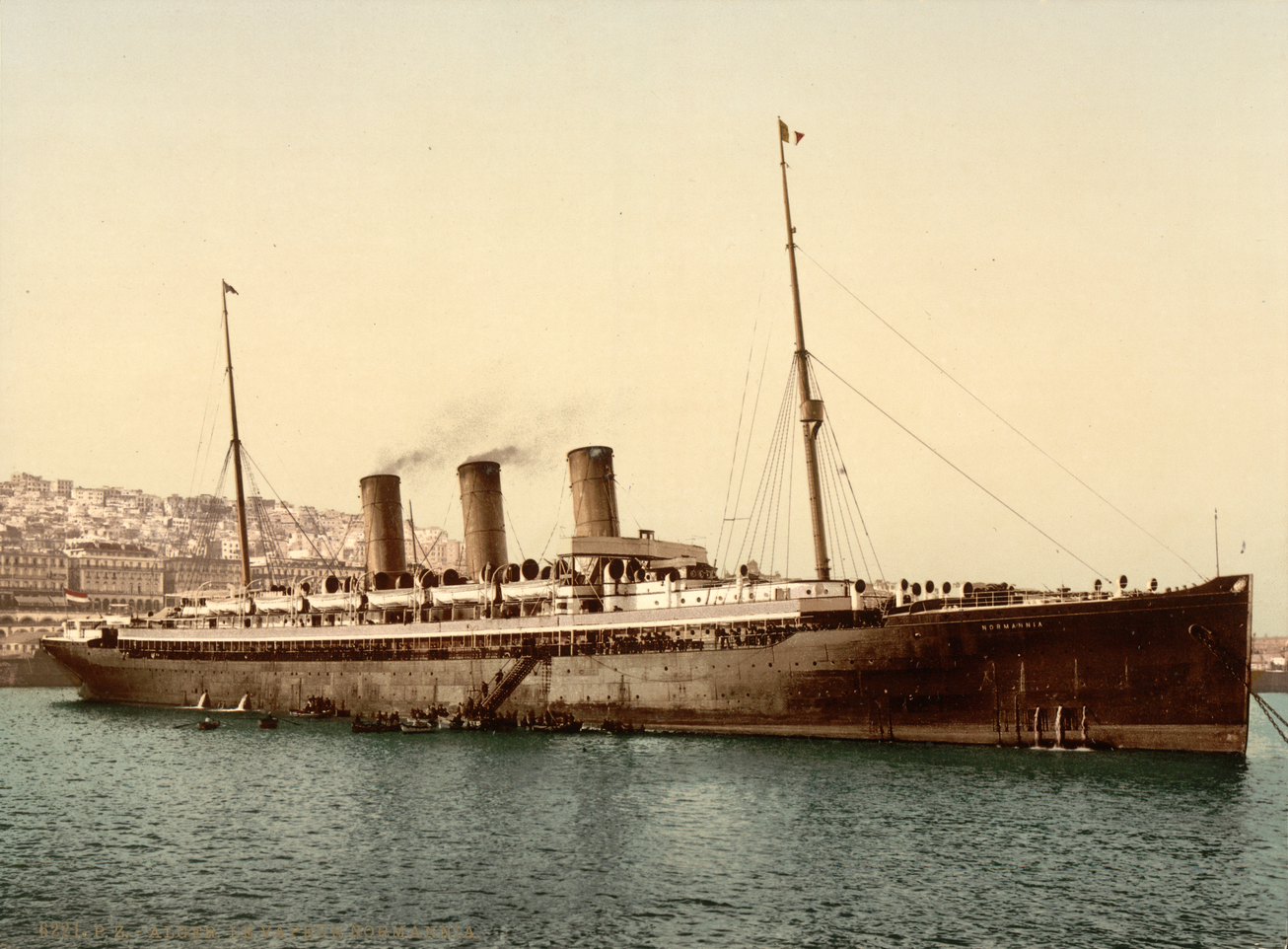
The SS Normannia was a prominent German ocean liner owned by the Hamburg America Line, launched on 9 February 1890. Constructed by Fairfield Shipbuilding and Engineering Company in Govan, Scotland, she was the largest and most powerful vessel built by that yard at the time. She formed part of a quartet of similar vessels designed to establish Hamburg America Line's weekly express service from Hamburg to New York via Southampton. Her sister ships included Augusta Victoria, Columbia, and Fürst Bismarck. Normannia featured twin screw propellers powered by two triple-expansion engines, each with three cylinders, housed in separate engine rooms. Her electrical system, supplied by Siemens, comprised four dynamos and 1,100 Edison-Swan lamps, providing extensive lighting throughout the vessel. The interior was crafted by the Bembe Furniture Factory in Mainz, characterized by lavish and ornate German design, including heavy gilt moldings and frescoes by renowned artists. During her official speed trials in the Firth of Clyde, Normannia achieved just under 21 knots, and her maiden voyage from Southampton to New York averaged 19.25 knots, with a guaranteed speed of 19 knots. Her design emphasized both power and comfort, reflecting the standards of German liners of the period. In January 1894, she suffered a significant mishap when a "mast-high" freak wave struck her en route from New York to Algiers, causing extensive damage to deck structures, flooding parts of the steerage area with six feet of water, and injuring seven men and the second officer. In 1898, Normannia was requisitioned by the Spanish Navy for use in the Spanish–American War, renamed Patriota, and lengthened to 521 feet. She was armed with four 5.5-inch guns, protected by 3.5-inch-thick shields, though she saw limited action. The following year, she was acquired by the French shipping company Compagnie Générale Transatlantique and renamed L'Aquitaine. She remained in service until her scrapping in September 1906. The vessel's notable combination of engineering power, luxurious interiors, and service history underscores her significance in maritime history.
This description has been generated using GPT-4.1-NANO based on the Vessel's wikidata information and then modified by ShipIndex.org staff.