
HMCS Kirkland Lake
1944 River-class frigate
Vessel Wikidata
* This information from Wikidata is available under the Creative Commons Attribution-ShareAlike License
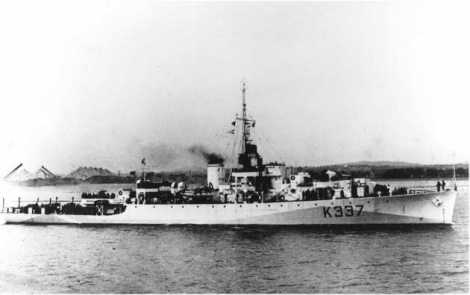
HMCS Kirkland Lake was a River-class frigate that served with the Royal Canadian Navy during the Second World War, primarily operating as a convoy escort in the Battle of the Atlantic. The vessel was originally laid down as St. Jerome on 16 November 1943 by Morton Engineering & Dry Dock Co. in Quebec City, with her launch occurring on 27 April 1944. Her name was later changed to Kirkland Lake, in honor of the Ontario town, prior to her commissioning into the RCN on 21 August 1944. Designed by William Reed of Smith's Dock Company, the River-class frigate was an improved successor to the Flower-class corvette, with notable enhancements in accommodation, range, and anti-submarine warfare capabilities. The class was initially called "twin-screw corvette," but the term "frigate" was adopted upon the suggestion of Vice-Admiral Percy Nelles. The design featured twin engines that provided a modest increase in speed—about three knots—but extended the operational range to nearly 7,200 nautical miles at 12 knots, a significant advantage for Atlantic convoy escort missions. Armament included a twin 4-inch gun mount forward, a 12-pounder aft, and anti-submarine weaponry such as Hedgehog mortar, depth charge rails, and side-mounted throwers. Kirkland Lake was equipped with advanced sonar and radar systems, including the 147B Sword horizontal fan echo sonar transmitter, which allowed her to maintain contact with submarines even while engaging them. Her anti-submarine suite was further enhanced by ASDIC and improved detection equipment, making her an effective convoy protector. After working up in Bermuda in November 1944, Kirkland Lake joined escort group EG 16 out of Derry, escorting convoys across the Atlantic and to Gibraltar. In May 1945, she participated in convoy escort missions from Portsmouth and Derry. Following the war's end, she underwent a tropicalization refit in Quebec City to prepare for service in the Pacific, but the war concluded before deployment. She was paid off on 14 December 1945 and subsequently sold for scrap in 1947, ending her service as a notable example of Canadian naval wartime construction and anti-submarine warfare advancements during WWII.
This description has been generated using GPT-4.1-NANO based on the Vessel's wikidata information and then modified by ShipIndex.org staff.