
HMCS Runnymede
1943 River-class frigate
Vessel Wikidata
* This information from Wikidata is available under the Creative Commons Attribution-ShareAlike License
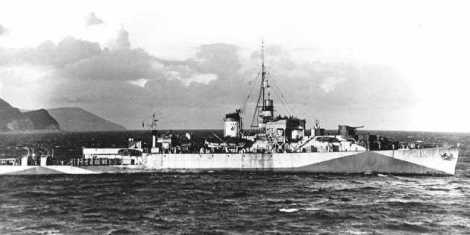
HMCS Runnymede was a River-class frigate serving with the Royal Canadian Navy during the Second World War, primarily functioning as a convoy escort in the Battle of the Atlantic. Laid down on September 11, 1943, by Canadian Vickers Ltd. in Montreal, Quebec, and launched on November 27, 1943, she was commissioned into service on June 14, 1944. Named after York, Ontario, her designation reflects a connection to that community, although her name also evokes her association with nearby West York. The River-class frigate was designed by William Reed of Smith's Dock Company to improve upon earlier convoy escort vessels like the Flower-class corvette. The design featured enhanced accommodations, slightly increased speed with twin engines (allowing for a top speed of a few knots more than corvettes), and a significantly extended range of approximately 7,200 nautical miles at 12 knots. Her armament included a twin 4-inch gun mount forward, a 12-pounder aft, and anti-submarine weaponry such as a Hedgehog mortar, depth charge rails, and side-mounted throwers. Notably, Runnymede was equipped with the 147B Sword horizontal fan echo sonar transmitter, alongside ASDIC, allowing her to maintain contact with submarines even while attacking. Constructed in Canadian shipyards along the St. Lawrence River, she was part of Canada's initial order of 33 frigates, with a total of 60 built, including some transferred to the Royal Navy and U.S. Navy. After working up at Bermuda, Runnymede joined the Mid-Ocean Escort Force escort group C-5, serving as a convoy escort across the Atlantic until May 1945. She also served as the Senior Officer's Ship for her group, which was known as the "Barber Pole Squadron" due to the distinctive markings on their funnels. In June 1945, she arrived in Halifax before heading to Esquimalt, British Columbia, for a tropicalization refit intended for service in the Pacific. The refit, begun in August 1945, included installing refrigeration and water-cooling systems and updating her camouflage. However, the end of the war following Japan's surrender led to the cancellation of her refit. Runnymede was subsequently placed in reserve and paid off on January 19, 1946. She was sold for scrap in 1947, with her hull repurposed as a breakwater in Kelsey Bay, British Columbia, marking the end of her maritime service.
This description has been generated using GPT-4.1-NANO based on the Vessel's wikidata information and then modified by ShipIndex.org staff.