
USS Los Angeles
rigid airship ZR-3 (1924)
Vessel Wikidata
* This information from Wikidata is available under the Creative Commons Attribution-ShareAlike License
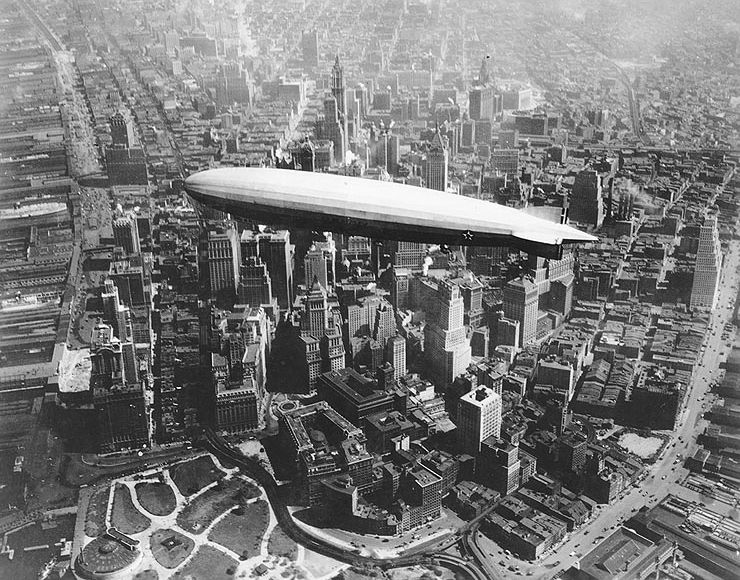
The USS Los Angeles (ZR-3) was a notable rigid airship constructed between 1923 and 1924 by the Zeppelin company in Friedrichshafen, Germany, as war reparations for the United States. Built under the Zeppelin works number LZ 126, it was designed primarily as a passenger airship, adhering to Treaty of Versailles restrictions that limited military airship construction. The hull featured a 24-sided transverse ring frame structure along most of its length, transitioning to an octagonal shape at the tail, with an internal keel serving as a walkway and crew accommodation when off duty. The ship's length was supported by main frames spaced approximately 32 feet 10 inches (10.01 meters) apart, with secondary frames in each bay. Powered by five Maybach VL I V12 engines, each housed in individual engine cars, the Los Angeles was capable of driving two-bladed, pusher-type propellers, with the engines arranged four in wing cars and one on the centerline aft. Auxiliary power was supplied by wind-driven dynamos. The hull housed crew and passenger compartments near the front, integrated into the structure, and was initially filled with hydrogen but later converted to helium to enhance safety. The airship’s first flight occurred on August 27, 1924, followed by an 81-hour transatlantic flight to the U.S. Naval Air Station Lakehurst, New Jersey. She was commissioned into the U.S. Navy on November 25, 1924, under Lieutenant Commander Maurice R. Pierce. After her arrival, her lifting gas was replaced with helium, and water recovery equipment was installed to optimize buoyancy during long flights. Over her operational life, the USS Los Angeles accumulated 4,398 hours of flight time over 172,400 nautical miles, serving as an experimental platform, observatory, and training vessel. Notable events included an attempted observation of a solar eclipse in 1925, a wind-induced tail lift incident in 1927, and testing of the Navy’s trapeze system for launching aircraft in 1929. She also participated in Fleet Problems and technological demonstrations, including a 1932 photophone communication test. Decommissioned in 1932 due to budget constraints, she was briefly recommissioned after the USS Akron crash in 1933, before ultimately being dismantled in 1939. The USS Los Angeles remains significant as the longest-serving U.S. Navy rigid airship, distinguished by her relatively accident-free service compared to other German-built Navy airships.
This description has been generated using GPT-4.1-NANO based on the Vessel's wikidata information and then modified by ShipIndex.org staff.