
SS Zeeland
British and Belgian ocean liner (1900-1930)
Vessel Wikidata
* This information from Wikidata is available under the Creative Commons Attribution-ShareAlike License
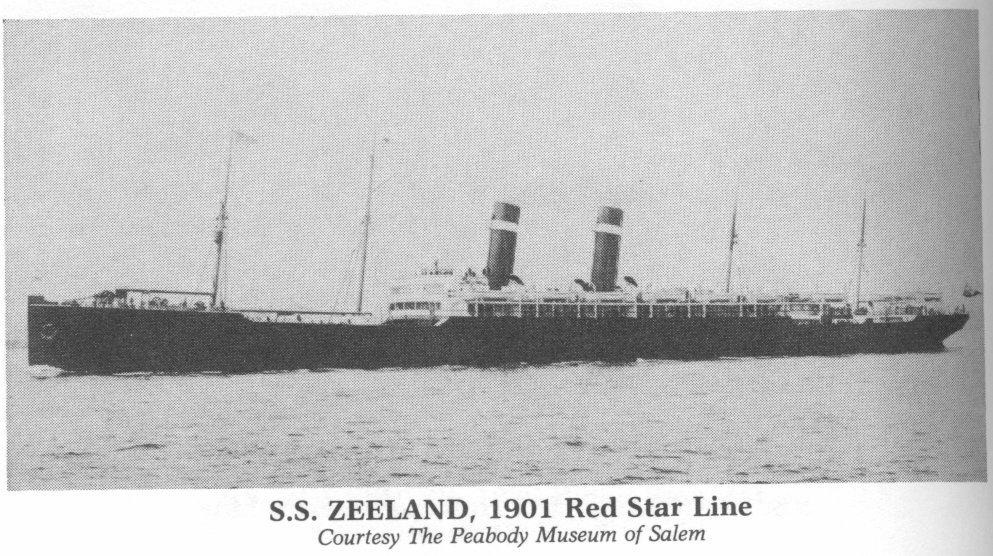
The SS Zeeland was a notable British and Belgian ocean liner constructed by John Brown & Company of Clydebank, Scotland, and launched on 24 November 1900. She was part of the International Mercantile Marine Co. (IMM) fleet and served as a sister ship to Vaderland, with near sister ships Kroonland and Finland. The vessel was primarily designed for transatlantic passenger service, featuring a robust steel hull and powered by steam engines typical of early 20th-century liners. Initially sailing under the British flag, Zeeland commenced her maiden voyage from Antwerp to New York on 13 April 1901. She operated mainly on the Antwerp–New York route, providing immigrant and tourist service across the Atlantic, often competing with other IMM lines. She also occasionally served under charter to other IMM subsidiaries, including the White Star Line, with whom she operated between Liverpool and Boston starting in April 1910 until September 1911. In July 1912, Zeeland was reflagged as a Belgian vessel but continued her usual route. With the outbreak of World War I in August 1914, Zeeland was reflagged as a British ship and shifted her service to routes from Liverpool to North American ports, including Halifax, Portland, Quebec, and Montreal. During the war, she was renamed SS Northland to avoid German associations and was briefly converted into a British troop ship, designated HMT Northland. Post-war, she resumed passenger services, including Liverpool–Halifax–Portland and Liverpool–Quebec–Montreal routes, operating under her Dutch name despite her reflags. Later, Zeeland was converted to serve only cabin and third-class passengers. In 1920, after refurbishment, she returned to the Antwerp–New York service under the Red Star Line. Transferred to the Atlantic Transport Line in 1927, she was renamed SS Minnesota and shifted to tourist service between London and New York. Her career concluded in September 1929, and she was sold for scrap in 1930 at Inverkeithing. Remarkably, her purser’s safe survived the scrapyard and was kept in private possession for decades, underscoring her maritime historical significance.
This description has been generated using GPT-4.1-NANO based on the Vessel's wikidata information and then modified by ShipIndex.org staff.