
SS Belgic
Vessel Wikidata
* This information from Wikidata is available under the Creative Commons Attribution-ShareAlike License
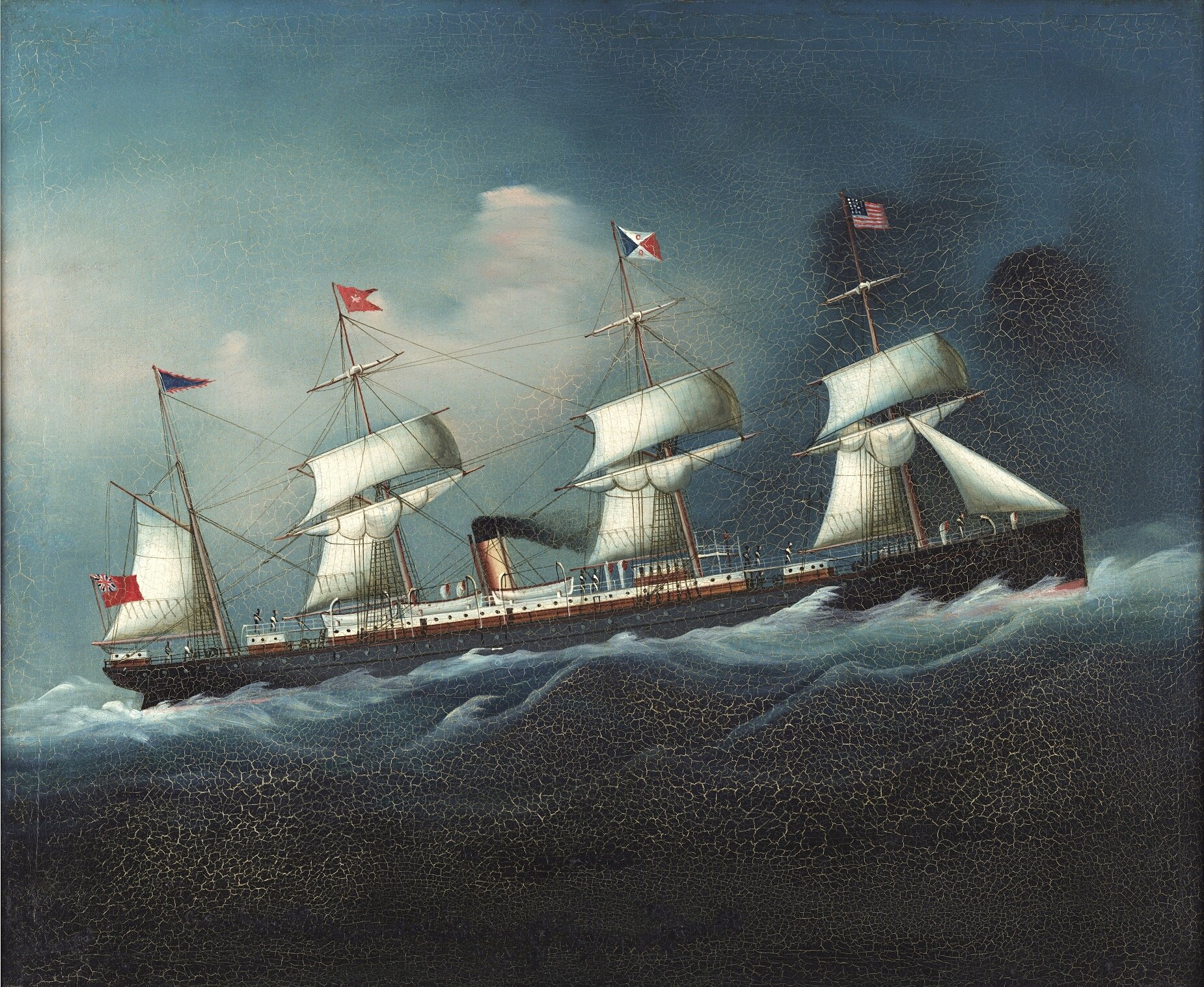
The SS Belgic, launched on 14 January 1873, was a steamship built by Harland & Wolff for the White Star Line. She was the first of four vessels to bear the name Belgic. Designed with a tapered, Oceanic-class-inspired hull, her length-to-beam ratio was approximately 10:1. She was powered by a compound steam engine built in Liverpool, propelling her via a screw propeller, and also carried four masts to support sails, reflecting her transitional design. Originally intended as a cargo vessel, she was modified to include accommodations for 40 first-class passengers, aligning with White Star’s emerging passenger services. Initially, the Belgic was assigned to a short-lived route to France and South America, making her maiden voyage from Liverpool to Valparaíso on 29 March 1873. She was the last White Star steamer to operate on this route before the company withdrew from it by December 1873. Subsequently, she was transferred to the North Atlantic route, making a single crossing to New York in May 1874, during which she notably rescued and towed the Spanish steamer Tornas. Despite her service, she remained surplus to White Star’s needs, which was compounded when the company introduced larger ships like the Germanic and Britannic. In 1875, the Belgic was chartered along with her sister ship Gaelic by the Occidental and Oriental Steamship Company for Pacific service, connecting San Francisco, Yokohama, and Hong Kong. This contract was extended to eight years and marked a significant chapter in her career. In 1883, she was sold to the Spanish company Cia de Nav. La Flecha and renamed Goefredo. Her career was short-lived, marred by two groundings—the first at Santiago de Cuba and the second at the mouth of the River Mersey in February 1884—both of which caused irreparable damage, leading to her loss. The SS Belgic’s service history highlights her role as a transitional vessel during a period of maritime evolution and reflects the broader expansion efforts of White Star Line in the 1870s.
This description has been generated using GPT-4.1-NANO based on the Vessel's wikidata information and then modified by ShipIndex.org staff.