
Cassard
1896 D'Assas-class protected cruiser
Vessel Wikidata
* This information from Wikidata is available under the Creative Commons Attribution-ShareAlike License
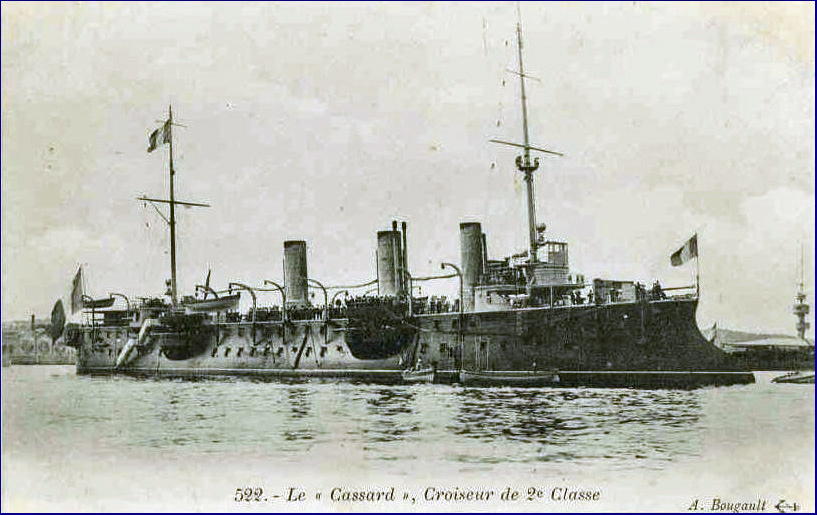
The French cruiser Cassard was a D'Assas-class protected cruiser constructed in the 1890s for the French Navy. Measuring approximately 99.65 meters in length with a beam of 13.68 meters and a draft of 5.8 meters, she displaced around 3,957 tons. Her propulsion system comprised twin triple-expansion steam engines powered by twenty coal-fired Lagrafel d'Allest water-tube boilers, enabling her to reach a top speed of about 20 knots. Her cruising range was substantial, with 6,000 nautical miles at 10 knots, making her suitable for both fleet actions and overseas duties. Armament included a main battery of six 164.7 mm guns, arranged with one on the forecastle, two in sponsons near the forward conning tower, and one on the stern. She also carried four 100 mm secondary guns, along with lighter anti-torpedo boat weapons: ten 47 mm guns, two 37 mm guns, and three 37 mm Hotchkiss revolvers. Her armament was complemented by two 356 mm torpedo tubes. The ship's armor consisted of a curved deck 30 to 80 mm thick and 60 mm plating on the conning tower, with gun shields providing additional protection. Commissioned in 1898, Cassard initially served with the Mediterranean Squadron, participating in routine training and fleet maneuvers. She was briefly reduced to reserve in 1905 but was reactivated in 1908, notably converted into a fast minelayer. During World War I, she operated primarily in Morocco, the western Mediterranean, and later in the Red Sea and Indian Ocean, performing patrols, convoy escort, and coastal bombardments, including actions to suppress unrest. Post-war, she served in the eastern Mediterranean, hosting notable figures such as Admiral Jellicoe in 1919. In 1921, Cassard was converted into a gunnery training ship, but she was eventually struck from the naval register in 1924. She was grounded in 1925 for use as a target and subsequently sold for scrap. Her service history reflects her versatility and importance within the French naval strategy during the late 19th and early 20th centuries, particularly in colonial policing and wartime patrols.
This description has been generated using GPT-4.1-NANO based on the Vessel's wikidata information and then modified by ShipIndex.org staff.