
Russian frigate Pallada
Russian 19th-century frigate
Vessel Wikidata
* This information from Wikidata is available under the Creative Commons Attribution-ShareAlike License
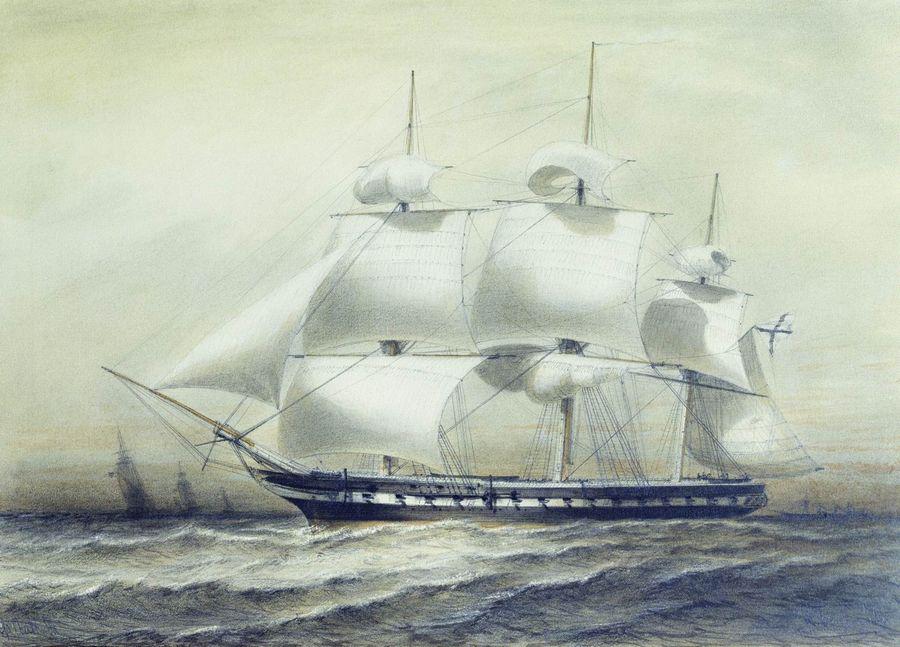
The Russian frigate Pallada was a notable sail-powered warship of the Imperial Russian Navy, constructed at the Admiralty Shipyard in Saint Petersburg. Launched in the early 1830s, she was a three-masted wooden frigate with a length of approximately 52.73 meters (173 feet) at the main deck and a maximum interior width of 13.31 meters (43.7 feet). Her hull was reinforced with transverse steel, and she was copper-sheathed to protect against marine organisms, a modern innovation at the time. Pallada's armament included 30 24-pounder guns on her upper deck and 22 24-pounder carronades on her quarterdeck and forecastle, giving her a nominal rating as a 44-gun frigate, with a crew complement of around 426 men. Designed for both diplomatic missions and scientific exploration, Pallada was intended to incorporate the latest innovations, as per Tsar Nicholas I’s imperial rescript. She was initially based at Kronstadt with the Baltic Fleet under Captain Pavel Nakhimov and served as a training ship for cadets between 1846 and 1848 after a thorough overhaul. Her service included transporting notable figures such as the future Prussian king Frederick William IV, and conducting missions across the Baltic and Mediterranean, including visits to Madeira, Lisbon, and the ports of South Africa, Singapore, Java, and Hong Kong. Pallada's most significant historical role was as the flagship of Vice Admiral Yevfimy Putyatin during his 1853 expedition to Japan. She departed Kronstadt in October 1852, navigating around the Cape of Good Hope due to risks associated with Cape Horn, and engaged in diplomatic and survey missions along the Japanese coast, Korea, and the Russian Far East. Her voyage was marked by encounters with typhoons, repairs, and scientific exploration, including collecting flora and fauna. During the Crimean War, Pallada overwintered at Imperatorskaya Gavan after her crew learned of the war's outbreak. Declared unfit for active service by 1855, she was eventually scuttled by her crew in 1855 due to her poor condition. Today, her sunken remains lie at a depth of approximately 20 meters, attracting divers and maritime historians alike, who often retrieve small artifacts from her wreck. Pallada remains a vessel of historical significance, symbolizing Russia’s naval, diplomatic, and exploratory endeavors of the mid-19th century.
This description has been generated using GPT-4.1-NANO based on the Vessel's wikidata information and then modified by ShipIndex.org staff.