
SMS Gneisenau
1906 Scharnhorst-class cruiser
Vessel Wikidata
* This information from Wikidata is available under the Creative Commons Attribution-ShareAlike License
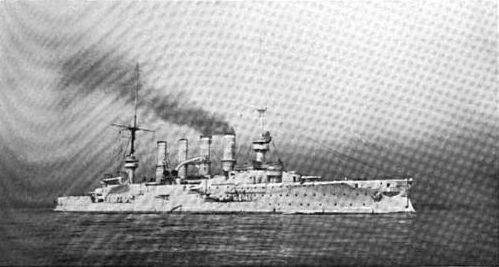
The SMS Gneisenau was an armored cruiser of the German Kaiserliche Marine, belonging to the Scharnhorst class, which included two ships designed for enhanced combat capability. Constructed at the AG Weser shipyard in Bremen, she was laid down in December 1904, launched in June 1906, and commissioned into service in March 1908. The vessel measured approximately 144.6 meters (474 feet 5 inches) in overall length, with a beam of 21.6 meters (70 feet 10 inches) and a draft of 8.37 meters (27 feet 6 inches). Her displacement was around 11,616 metric tons normally, increasing to 12,985 tons at full load. The ship's propulsion system comprised three triple-expansion steam engines powered by eighteen coal-fired water-tube boilers, which produced 26,000 metric horsepower, enabling a top speed of 22.5 knots (42 km/h; 26 mph). Gneisenau had a cruising radius of 4,800 nautical miles at 14 knots. Her armament included eight 21 cm (8.3 in) SK L/40 guns as her main battery, arranged with four in twin turrets fore and aft, and four in single casemates along the hull. The secondary armament consisted of six 15 cm (5.9 in) SK L/40 guns in casemates, while defense against smaller vessels was provided by eighteen 8.8 cm (3.5 in) guns. She also carried four 45 cm (17.7 in) submerged torpedo tubes. The ship's armor protection featured a 15 cm Krupp steel belt, with the central citadel protected by 17 cm (6.7 in) thick gun turret sides and 15 cm casemate armor, along with a deck thickness ranging from 3.5 to 6 cm (1.4 to 2.4 in). Gneisenau’s service history included participation in peacetime fleet cruises and diplomatic missions, such as showing the flag in foreign ports and monitoring events during the Xinhai Revolution in China. She was deployed to the German East Asia Squadron, patrolling colonial possessions in Asia and the Pacific. During World War I, she notably participated in the Battle of Coronel in November 1914, where she contributed to the German victory by disabling the British cruiser HMS Monmouth. However, she was sunk a month later at the Battle of the Falkland Islands, after a fierce engagement with British battlecruisers, which resulted in the loss of most of her crew and the destruction of the squadron. Her sinking marked a significant moment in naval history, illustrating the dominance of British naval power and the risks faced by the German cruiser squadron during the early years of WWI.
This description has been generated using GPT-4.1-NANO based on the Vessel's wikidata information and then modified by ShipIndex.org staff.