
USS Iwo Jima
cancelled Essex-class aircraft carrier
Vessel Wikidata
* This information from Wikidata is available under the Creative Commons Attribution-ShareAlike License
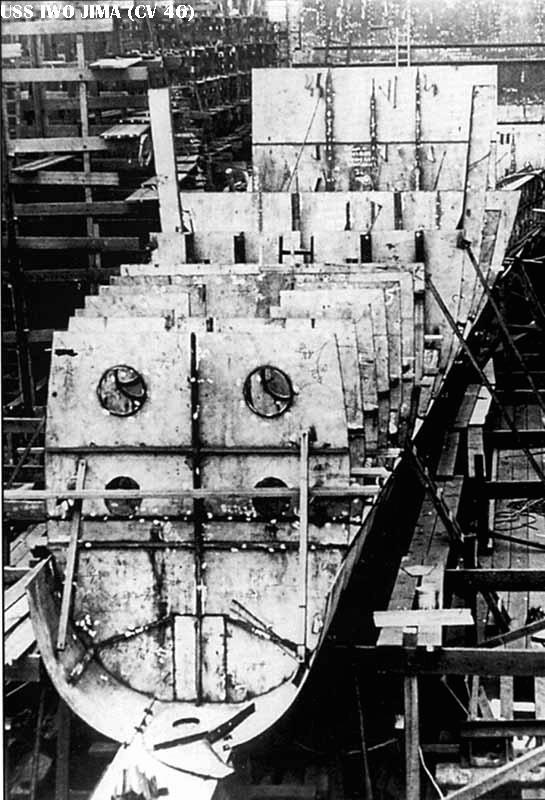
The USS Iwo Jima (CV-46) was an Essex-class aircraft carrier built for the United States Navy during World War II. Laid down in January 1945 at Newport News Shipbuilding, she was part of the largest class of U.S. aircraft carriers, designed to carry a substantial air group to project naval air power across vast distances. However, her construction was canceled in August 1945 due to the end of the war, and she was broken up on the slipway before commissioning. As an Essex-class vessel, Iwo Jima shared the class's key specifications, including a length over 800 feet, a beam of approximately 93 feet, and a displacement of around 27,000 tons standard. The class featured a flush flight deck with an armored hangar deck and was equipped with multiple armaments, including twelve 5-inch guns, anti-aircraft batteries of Bofors 40 mm, and Oerlikon 20 mm cannons, designed for both offensive operations and self-defense. The ships incorporated advanced radar and fire-control systems, such as SK air-search radars and Mark 37 fire control directors, enhancing their combat effectiveness. Although USS Iwo Jima was never completed or commissioned, the Essex class in general played a crucial role in U.S. naval history. These carriers served extensively in World War II, surviving kamikaze attacks, aerial bombardments, and typhoons without being sunk. Post-war, many underwent modifications, including the addition of angled flight decks, steam catapults, and enhanced armor, to accommodate jet aircraft and modern combat requirements. They participated in the Korean and Vietnam Wars, with some, like Lexington, serving into the 1990s as training ships or museum ships. The class became the backbone of U.S. naval aviation, earning recognition as one of the most significant classes of warships in American history. Several, including the USS Valley Forge, USS Intrepid, USS Hornet, and USS Lexington, have been preserved as museums, highlighting their enduring maritime and historical significance.
This description has been generated using GPT-4.1-NANO based on the Vessel's wikidata information and then modified by ShipIndex.org staff.