
Scotia
steamship and research vessel
Vessel Wikidata
* This information from Wikidata is available under the Creative Commons Attribution-ShareAlike License
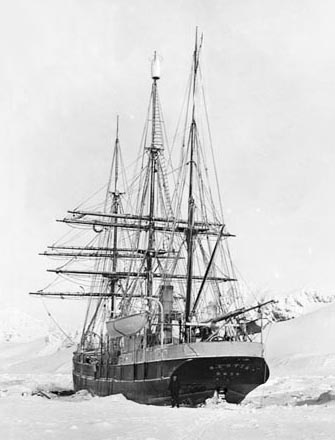
The Scotia was a barque measuring 139 feet 6 inches (42.5 meters) in length, with a beam of 28 feet 9 inches (8.8 meters) and a depth of 15 feet 6 inches (4.7 meters). Her gross register tonnage was assessed at 375 GRT. Originally built in 1872 by Jørgensen & Knudsen in Drammen as the Norwegian whaler Hekla, she was constructed for S. S. Svendsen of Sandefjord. As Hekla, she primarily served as a sealer, undertaking voyages to the east coast of Greenland from 1872 to 1882, and to Scoresby Sound in 1892. Throughout the late 19th century, she changed ownership several times, operated under different managements, including N. Bugge of Tønsberg and A/S Sæl- og Hvalfangerskib Hekla of Christiania. In 1902, she was purchased by William Speirs Bruce for kr 45,000 (£2,650) and renamed Scotia. The vessel was extensively refitted by the Ailsa Shipbuilding Company to serve as a research vessel for the Scottish National Antarctic Expedition. This transformation included internal strengthening with 25-inch (640 mm) thick beams to withstand ice pressure, and the installation of a new steam engine capable of 7 knots (13 km/h). The conversion was overseen by Fridtjof Nansen, and her captain was Thomas Robertson, an experienced Arctic and Antarctic sailor. Following sea trials in August 1902, Scotia embarked on her historic Antarctic voyage, arriving at the Falkland Islands in January 1903 and subsequently overwintering at Scotia Bay on Laurie Island, where she was frozen in for eight months. After the expedition, she was intended for further scientific use but was sold at auction. Scotia then served as a sealer, whaler, and later as a weather ship during the Titanic aftermath, equipped with Marconi wireless to monitor icebergs off Newfoundland. She also functioned as a collier between the UK and France. Her career ended when she caught fire and was destroyed in January 1916 in the Bristol Channel off Sully Island, with her crew surviving. The vessel’s maritime significance is underscored by features named after her, including the Scotia Sea and the Scotia Plate in the Antarctic region, and she has been commemorated on postage stamps of the Falkland Islands and the British Antarctic Territory.
This description has been generated using GPT-4.1-NANO based on the Vessel's wikidata information and then modified by ShipIndex.org staff.