
USS Ohio
1820 ship of the line
Vessel Wikidata
* This information from Wikidata is available under the Creative Commons Attribution-ShareAlike License
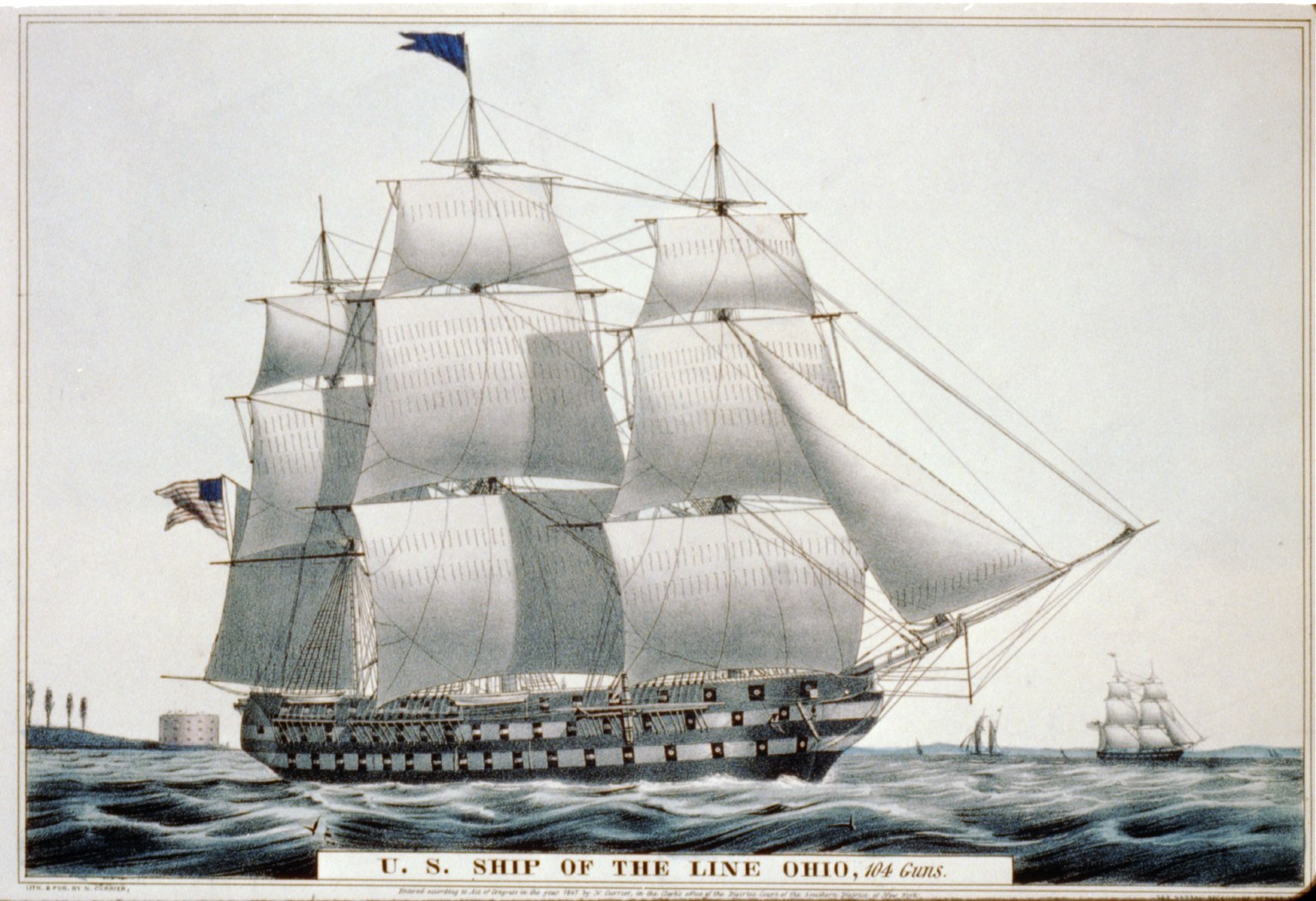
The USS Ohio (1820) was a notable ship of the line of the United States Navy, designed by Henry Eckford and constructed at the Brooklyn Navy Yard. Launched on May 30, 1820, she was rated at 74 guns but carried a total of 104, reflecting her formidable armament. The vessel's design and performance received high praise, with officers noting her excellent sailing capabilities, often exceeding 12 knots, and describing her as a near-perfect vessel. Initially placed in ordinary upon launch, the Ohio decayed over the years but was refitted for active service in 1838. She then sailed to join the Mediterranean Squadron under Commodore Isaac Hull, acting as flagship for two years. During this period, she played a key role in protecting commerce and suppressing the slave trade off the African coast, demonstrating her versatility and effectiveness under sail. In 1840, the Ohio returned to Boston and again entered ordinary status. From 1841 to 1846, she served as a receiving ship. Recommissioned on December 7, 1846, for the Mexican–American War, she participated in the Siege of Veracruz, landing guns to assist in the city’s capture. Her deep draft limited her coastal operations, but her crew engaged in the Tuxpan River Expedition, where she supported landings and helped capture strategic forts, including storming Fort LaPena under Commander Franklin Buchanan’s leadership. After the war, Ohio returned to New York and was assigned to the Pacific Squadron, serving as flagship for Commodore Thomas ap Catesby Jones. She helped transport U.S. personnel and protected American interests during the early California Gold Rush period. In 1851, she returned to Boston and resumed her role as a receiving ship until 1875. She was eventually sold in 1883 and burned the following year. Today, her remains rest off Fanning Point in Greenport Harbor, accessible to scuba divers, serving as a maritime relic of early 19th-century naval power and American maritime expansion.
This description has been generated using GPT-4.1-NANO based on the Vessel's wikidata information and then modified by ShipIndex.org staff.