
SMS Nürnberg
1916 Königsberg-class cruiser
Vessel Wikidata
* This information from Wikidata is available under the Creative Commons Attribution-ShareAlike License
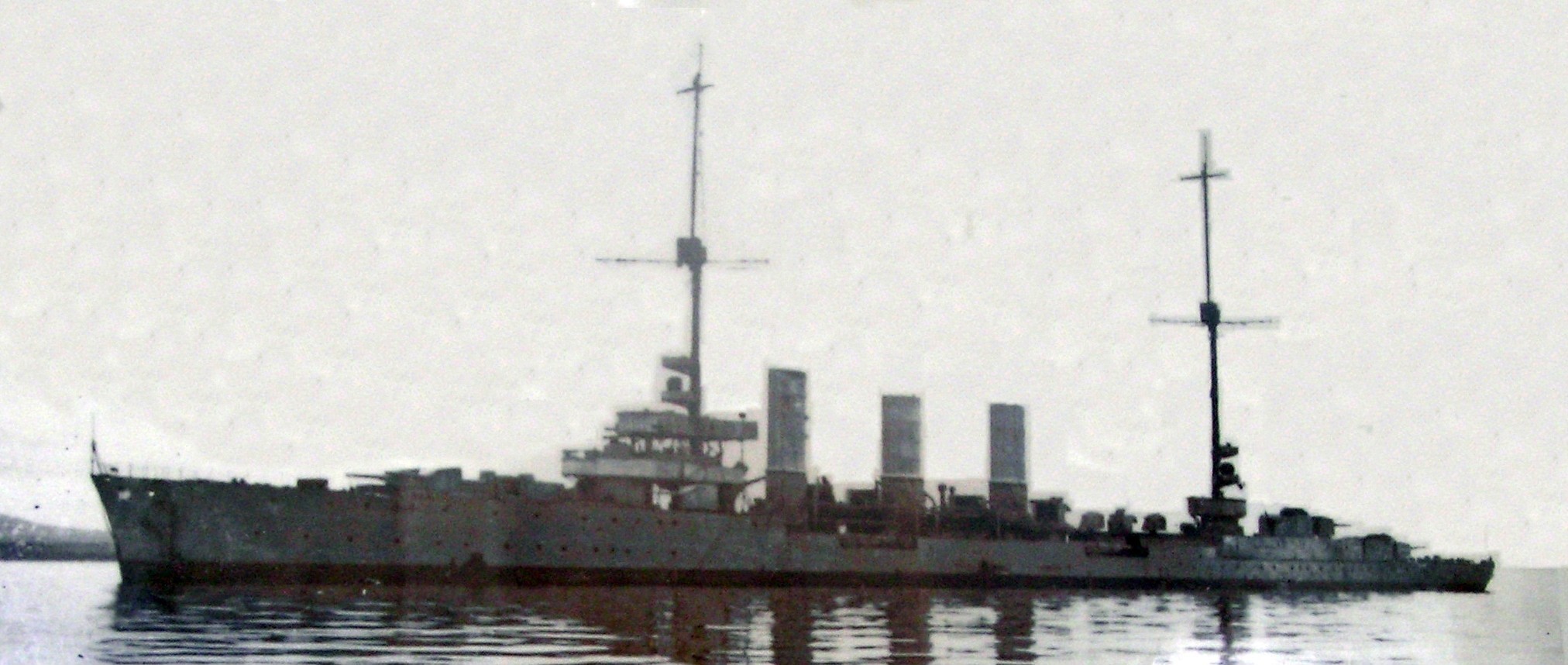
SMS Nürnberg was a Königsberg-class light cruiser constructed during World War I for the German Imperial Navy. Laid down in 1915 at the AG Weser shipyard in Bremen and launched in April 1916, she was commissioned in February 1917. The vessel measured approximately 151.4 meters in length overall, with a beam of 14.2 meters and a draft of nearly 6 meters. She displaced about 5,440 tons normally, increasing to over 7,125 tons at full load. Nürnberg featured a relatively small superstructure with a forward conning tower and two pole masts, and her hull included a long forecastle extending a third of her length. Powered by two steam turbines driving twin screw propellers, Nürnberg's engines generated 31,000 shaft horsepower, enabling a top speed of 27.5 knots. Her armament comprised eight 15 cm SK L/45 guns in single mounts, with two positioned forward, two amidships, and two superfiring aft. She also carried two 8.8 cm anti-aircraft guns, two 50 cm torpedo tubes with eight torpedoes, and was equipped to carry 200 mines. Armor protection included a 60 mm waterline belt and a 100 mm conning tower. During her service, Nürnberg participated in notable operations including the Baltic campaign in October 1917—supporting the seizure of Ösel and Moon Islands—and engagements in the North Sea. She was involved in the Second Battle of Helgoland Bight in November 1917, where she sustained light casualties from near misses. In 1918, she was part of the fleet’s final planned operations, which were canceled due to mutinies. After the German armistice, Nürnberg was interned at Scapa Flow and was among the ships scuttled by the German fleet in June 1919 to prevent capture. She was subsequently salvaged and used as a target ship, enduring multiple shelling tests in 1920. Ultimately, Nürnberg was sunk as a target by the British battlecruiser Repulse in July 1922 off the Isle of Wight at a depth of 62 meters. Her remains lie on her side, serving as a significant wreck and testament to her role in wartime and interwar naval history.
This description has been generated using GPT-4.1-NANO based on the Vessel's wikidata information and then modified by ShipIndex.org staff.