
SMS Sophie
screw corvette of the German Imperial Navy

Vessel Wikidata
* This information from Wikidata is available under the Creative Commons Attribution-ShareAlike License
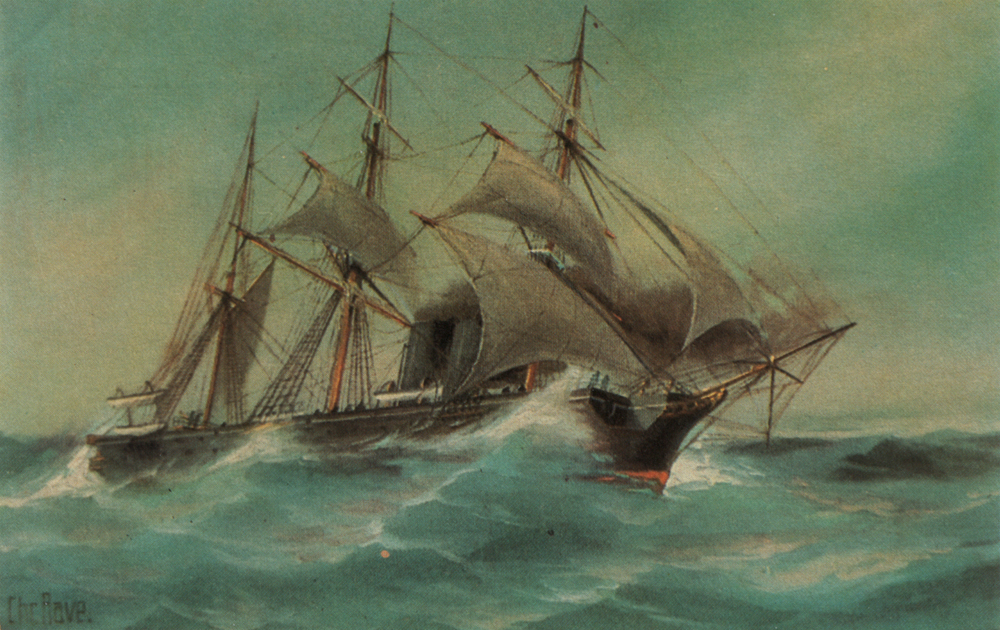
SMS Sophie was a Carola-class steam corvette built for the German Kaiserliche Marine in the early 1880s, measuring 76.35 meters (250 ft 6 in) in length overall with a beam of 12.5 meters (41 ft). Displacing approximately 2,424 metric tons at full load, she was designed for extended colonial service, featuring both steam and sail power. Her propulsion system consisted of a single marine steam engine driving a two-bladed screw propeller, powered by six coal-fired fire-tube boilers, enabling a top speed of 14 knots (26 km/h). She had a cruising radius of 3,420 nautical miles (6,330 km) at 10 knots. The ship was rigged with a three-masted barque sail plan to supplement her steam engines during long deployments. Armament comprised ten 15-centimeter (5.9-inch) 22-caliber breech-loading guns, two 8.7-centimeter (3.4-inch) 24-caliber guns, and six 37 mm Hotchkiss revolver cannons. Later in her career, her armament was modified to include two 8.8-centimeter (3.5-inch) SK L/30 guns and additional machine cannons. Constructed at the Kaiserliche Werft in Danzig, Sophie was launched in November 1881 and completed by August 1882. She was initially used for training and fleet exercises, but her early service included notable diplomatic and colonial patrol missions. In 1883, she escorted Crown Prince Friedrich Wilhelm to Spain, and subsequently served in West Africa to protect German commercial interests amidst local conflicts in Togo. Her actions included anchoring off Lomé and negotiating with local chiefs, sometimes engaging in limited landing operations. Throughout her service, Sophie participated in training cruises across the Baltic, North Sea, West Indies, and in East Asian waters, including Samoa, German New Guinea, and China. She also served in the Pacific, notably in Samoa and the Bismarck Archipelago, and was involved in safeguarding German nationals during regional conflicts such as the Chilean Civil War of 1891. Her operational history was marked by periods of repairs, including damage from collisions and cyclone-related incidents. Decommissioned in 1892, Sophie resumed training duties in 1898, but her role diminished, and by 1908 she was repurposed as a barracks ship. She was transferred to Helgoland during World War I, later moved to Emden, and eventually sold for scrap in 1920. Sophie’s career exemplifies the transition of the German colonial navy from active warship deployment to support and training roles, reflecting the evolving strategic priorities of the Kaiserliche Marine during the late 19th and early 20th centuries.
This description has been generated using GPT-4.1-NANO based on the Vessel's wikidata information and then modified by ShipIndex.org staff.