
Georgii Pobedonosets
1892 Ekaterina II-class battleship
Vessel Wikidata
* This information from Wikidata is available under the Creative Commons Attribution-ShareAlike License
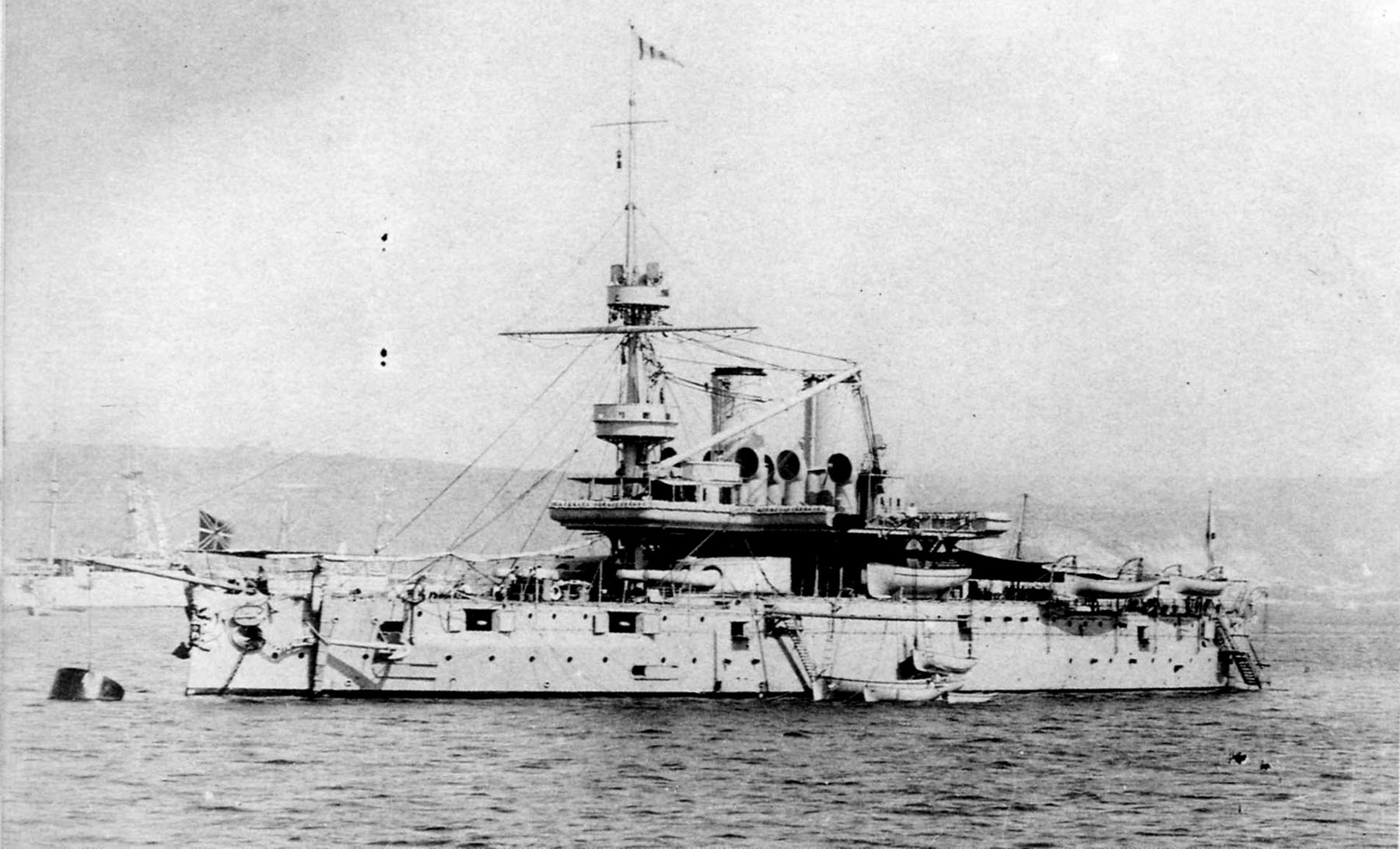
The Georgii Pobedonosets was a battleship constructed for the Imperial Russian Navy, serving primarily in the Black Sea Fleet. As the fourth and final vessel of the Ekaterina II class, she differed from her sister ships due to a modified armor scheme and later construction date. Laid down on May 5, 1891, at Sevastopol by the Russian Steam Navigation Company, she was launched on March 9, 1892, and completed in 1893, with trials lasting until mid-1895. Her overall length was approximately 347.5 feet (105.9 meters) at the waterline, with a beam of 68 feet 11 inches (21.0 meters) and a draft of 27 feet 11 inches (8.5 meters). She displaced about 11,032 long tons (11,209 tonnes) at load, exceeding her designed displacement. Powered by two 3-cylinder vertical triple-expansion steam engines and sixteen boilers imported from the UK, she produced 9,843 indicated horsepower, reaching a top speed of 16.5 knots. The ship's main armament consisted of three twin turrets with 12-inch (305 mm) Obukhov Model 1886 guns, mounted side-by-side forward and one aft. These guns could elevate up to 15° and had a maximum range of approximately 11,600 yards. Her secondary armament included seven 6-inch (152 mm) guns, mounted in hull embrasures, and various smaller caliber guns for defense against torpedo boats, along with ten 14-inch (356 mm) torpedo tubes. Her armor scheme was notable for its steel construction, with a belt thickness reaching 16 inches (410 mm), though her belt only extended six inches above the waterline due to weight considerations. The deck armor was 2.25 inches thick outside the citadel, tapering to 1.5 inches over it. Throughout her service, Georgii Pobedonosets engaged in notable events such as the 1905 Potemkin mutiny, where her crew initially supported the rebels before regaining control and surrendering. She also participated in shelling Sevastopol during World War I and served mainly as a headquarters ship. After the Russian Revolution and Civil War, she was captured by various forces, towed to Bizerte, and eventually scrapped between 1930 and 1936. Her operational history highlights her role in the tumultuous naval history of Russia and her participation in significant naval conflicts of the early 20th century.
This description has been generated using GPT-4.1-NANO based on the Vessel's wikidata information and then modified by ShipIndex.org staff.