
Mayflower II
replica of the 17th-century ship Mayflower
Vessel Wikidata
* This information from Wikidata is available under the Creative Commons Attribution-ShareAlike License
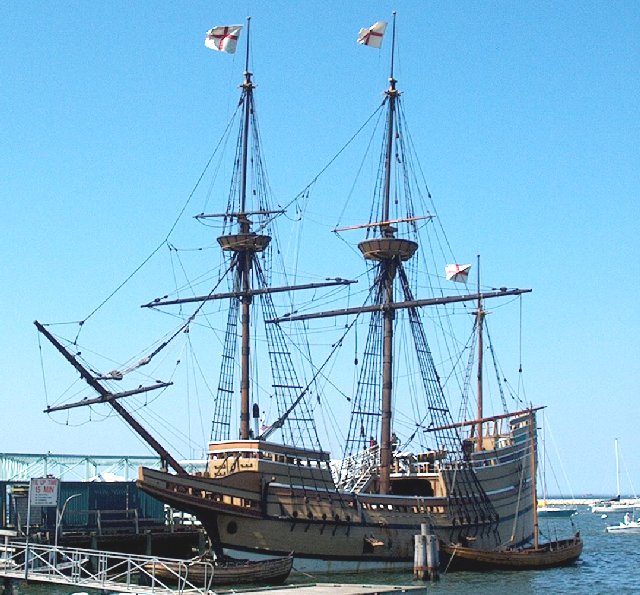
Mayflower II is a historically significant reproduction of the 17th-century ship Mayflower, built to commemorate the Pilgrims' voyage to America in 1620. Constructed in 1955–1956 at the Upham Shipyard in Brixham, Devon, England, the vessel was a collaborative effort between English shipbuilders and the Plimoth Patuxet Museum, drawing upon detailed blueprints and traditional shipbuilding techniques. The ship measures approximately 106 feet (32 meters) in length and 25 feet (7.6 meters) in width, with a displacement of 236 tons. Its hull is crafted from carefully selected English oak timbers, featuring a brown color with dark-red strapwork ornamentation, reflective of 17th-century merchant ships. The vessel is rigged with three masts—mainmast, foremast, and mizzen—supporting a total of six sails, with tarred hemp rigging and hand-sewn linen canvas sails, maintaining historical accuracy. Launched on September 22, 1956, Mayflower II was designed to be a faithful replica, employing traditional construction methods and materials, including hand-forged nails and Stockholm tar. Its maiden voyage began on April 20, 1957, under the command of Alan Villiers, who navigated the ship across the Atlantic via a route that included a wide southern loop to avoid dismasting, ultimately arriving in Plymouth on June 22, 1957. The voyage symbolized Anglo-American cooperation during and after World War II, and upon arrival in New York City, the ship was celebrated with a ticker-tape parade. Since its arrival, Mayflower II has served as a maritime and cultural icon, moored at Long Wharf near Plymouth Rock and serving as a tourist attraction. Notably, it was involved in a protest by the American Indian Movement in 1970. Over the decades, the vessel has undergone extensive restorations, including a major overhaul in 2012–2013, and further restoration at Mystic Seaport beginning in 2015. It was returned to Plymouth in 2020 for the 400th anniversary of the Pilgrims’ landing, reaffirming its maritime and historical significance as a symbol of early American exploration and Anglo-American heritage.
This description has been generated using GPT-4.1-NANO based on the Vessel's wikidata information and then modified by ShipIndex.org staff.