
HMS York
1928 York-class heavy cruiser
Vessel Wikidata
* This information from Wikidata is available under the Creative Commons Attribution-ShareAlike License
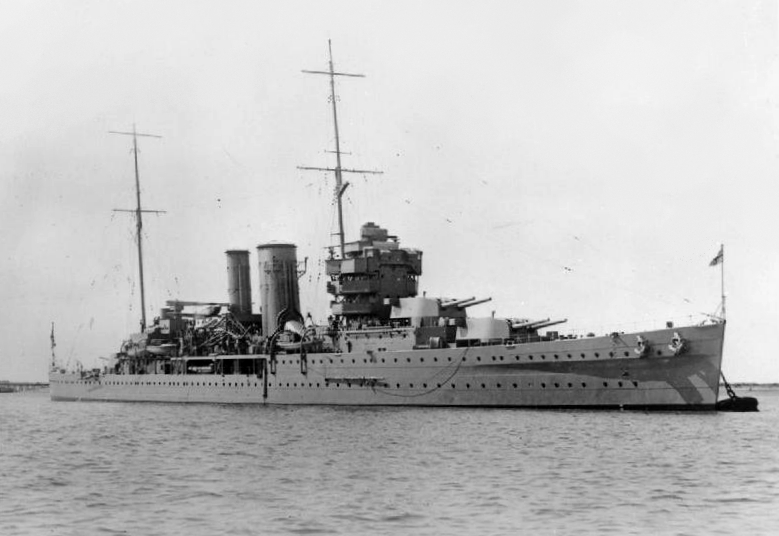
HMS York was the lead ship of her class of two heavy cruisers built for the Royal Navy in the late 1920s. Displacing approximately 8,250 long tons at standard load and up to 10,620 long tons at deep load, she measured 575 feet in overall length, with a beam of 57 feet and a draught of 20 feet 3 inches. Her propulsion system consisted of Parsons geared steam turbines driving four shafts, producing 80,000 shaft horsepower, which allowed her to reach a maximum speed of 32.25 knots. Steam was generated by eight Admiralty 3-drum water-tube boilers. She carried a fuel oil capacity of 1,900 long tons, giving her an operational range of about 13,300 nautical miles at 12 knots. The ship's complement was approximately 628 officers and ratings. Her armament comprised six 8-inch (203 mm) guns mounted in three twin turrets, providing heavy firepower typical of cruisers of her era. Additionally, she was equipped with four single 4-inch (102 mm) anti-aircraft guns and two single 2-pounder (40 mm) pom-poms for close-range air defense. Her torpedo armament included two triple 21-inch (533 mm) torpedo tubes. While she lacked a full waterline armor belt, her vital areas such as the magazine and machinery spaces were protected by up to 4.375 inches of armor on the sides, with additional armor on bulkheads and decks to mitigate damage. Constructed by Palmers Shipbuilding and Iron Company, she was laid down on 18 May 1927, launched on 17 July 1928, and completed on 1 May 1930. HMS York served as the flagship of various cruiser squadrons, notably on the America and West Indies Station and later in the Mediterranean Fleet. Her early service included convoy escort duties, participation in the Norwegian Campaign, and patrols against German and Italian forces. Noteworthy actions include her sinking the Italian destroyer Artigliere during operations off Cape Passero in October 1940 and her involvement in the attack on Italian shipping and airfields in the Mediterranean. Her service ended tragically in March 1941 at Suda Bay, Crete, where she was damaged beyond repair by Italian explosive motorboats of the Decima Flottiglia MAS, which struck her amidships with 330 kg charges. Despite attempts to save her, further damage from German bombers rendered her irreparable, and her wreck was salvaged in 1952 and scrapped. HMS York's brief but active career exemplifies the versatility and peril of early 20th-century cruisers in wartime operations.
This description has been generated using GPT-4.1-NANO based on the Vessel's wikidata information and then modified by ShipIndex.org staff.