
USS Charleston
American protected cruiser
Vessel Wikidata
* This information from Wikidata is available under the Creative Commons Attribution-ShareAlike License
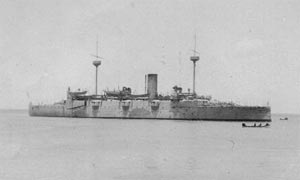
The second USS Charleston (C-2) was a United States Navy protected cruiser launched on July 19, 1888, by Union Iron Works in San Francisco and commissioned on December 26, 1889, under the command of Captain George C. Remey. As the fourth US protected cruiser, she was constructed based on design plans purchased from the British firm Armstrong, Mitchell and Co., which were similar to those used for the cruiser Naniwa. Her design aimed to improve upon earlier "ABC" cruisers with enhanced protection, increased speed, and comparable armament. Constructed with a steel hull, Charleston featured a main armament of two 8-inch (203 mm)/35 caliber guns in bow and stern barbettes, and six 6-inch (152 mm)/30 caliber guns mounted along her sides in sponsons. Due to initial unavailability of her 8-inch guns, she temporarily carried four additional 6-inch guns until a 1891 refit. Her secondary armament included 6-pounder, 3-pounder Hotchkiss revolving cannons, Gatling guns, and four torpedo tubes which were never mounted. Her armor consisted of a protective deck up to 3 inches thick, with additional armor on gun shields and barbettes. Powered by six coal-fired cylindrical boilers and two horizontal compound engines producing 7,500 indicated horsepower, Charleston could reach speeds of 18.2 knots. She carried approximately 328 tons of coal, providing a range of nearly 3,000 nautical miles at 10 knots. Notably, she was the last US Navy ship equipped with older compound engines, predating more efficient triple expansion designs. Throughout her service, Charleston operated primarily in the Pacific and Far East, serving as flagship for the Pacific and Asiatic Squadrons. She participated in various diplomatic missions, including transporting the remains of Hawaiian King David Kalakaua and enforcing neutrality during the Chilean Civil War. During the Spanish–American War, she played a significant role in the capture of Guam, where she raised the American flag and accepted the Spanish surrender. Subsequently, she participated in the blockade and bombardment of Manila, aiding in the Spanish surrender of the city. Her service ended when she grounded on Guinápac Rocks near Luzon on November 2, 1899. The wreck was beyond salvage, marking her as the first steel-hulled ship lost by the US Navy. Her loss was a notable event in naval history, illustrating the perils of early steel cruiser operations.
This description has been generated using GPT-4.1-NANO based on the Vessel's wikidata information and then modified by ShipIndex.org staff.