
CSS Albemarle
Confederate ram which was sunk, raised, and scrapped
Vessel Wikidata
* This information from Wikidata is available under the Creative Commons Attribution-ShareAlike License
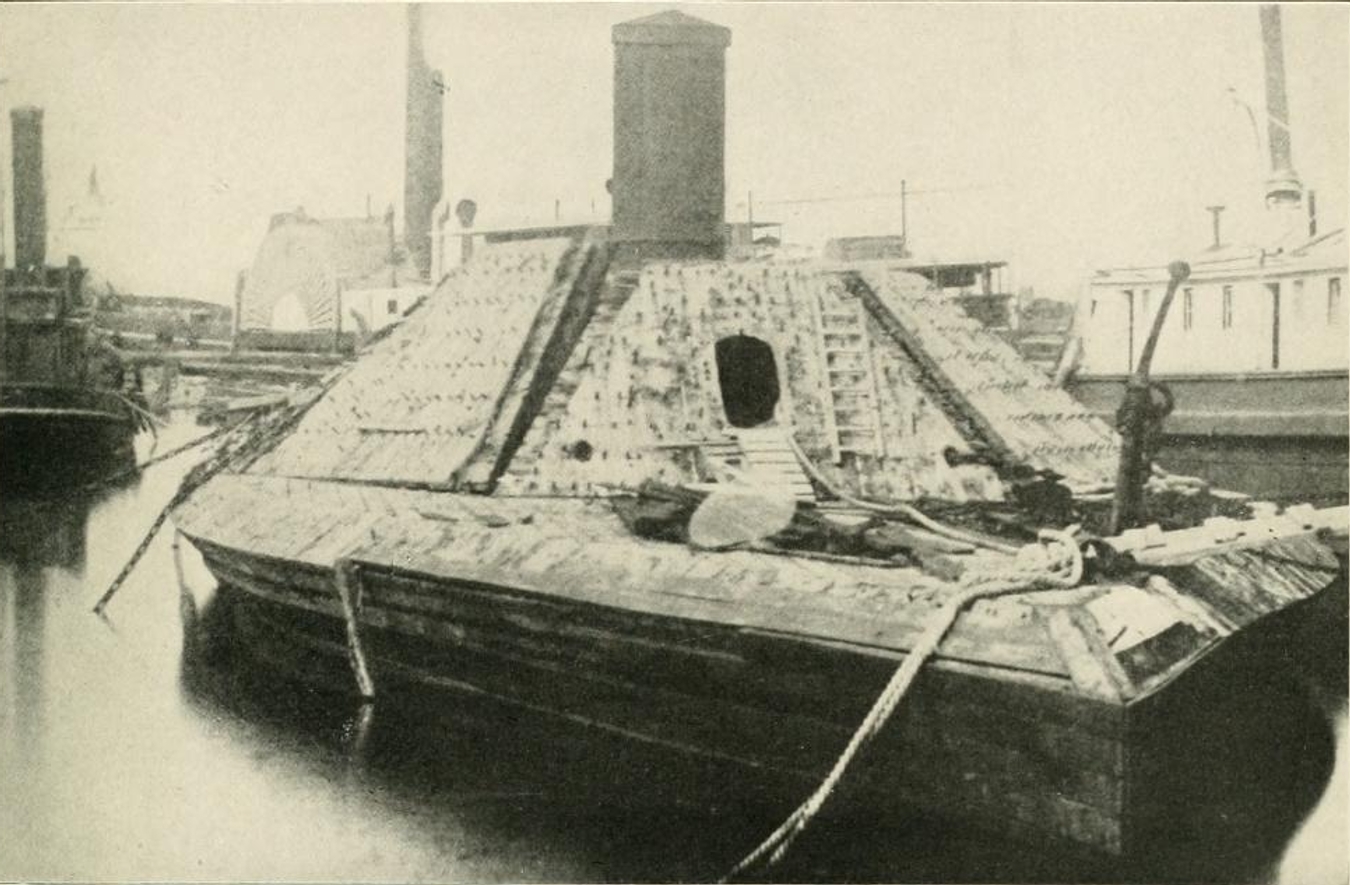
The CSS Albemarle was a Confederate steam-powered casemate ironclad ram built during the American Civil War, notable for its distinctive design and its role in naval engagements along North Carolina rivers. Constructed starting in January 1863 in a makeshift shipyard near Edward's Ferry, North Carolina, the vessel was overseen by Confederate Lieutenant Gilbert Elliott, with design finalized by Chief Constructor John L. Porter. The Albemarle measured approximately 160 feet in length and featured a robust armored casemate with eight inclined sides at 30 degrees, providing substantial protection. The vessel was powered by twin steam engines, each rated at 200 horsepower, driving twin screw propellers. Its armament consisted of two 6.4-inch Brooke rifled cannons mounted centrally within the casemate, capable of firing explosive shells, canister shot, grapeshot, and solid wrought iron bolts designed for armor penetration. The cannons could pivot to fire broadside from multiple gun ports, offering a 180-degree field of fire. The Albemarle's operational history began in April 1864 when Captain James W. Cooke led her upriver toward Plymouth, North Carolina, to clear Union forces from the area. Her armor protected her from Union artillery during her passage, but her encounter with Union paddle steamers USS Miami and USS Southfield resulted in her ramming Southfield and becoming temporarily trapped. During this engagement, Miami fired a shell that ricocheted off her armor, killing her commanding officer but failing to disable her. Subsequently, the Albemarle played a pivotal role in Union attempts to control the Roanoke River, engaging Union ships during the Battle of Albemarle Sound in May 1864. She successfully resisted multiple Union attacks, including ramming USS Sassucus, which resulted in a fierce exchange of gunfire and damage to both vessels. Her most notable event was her destruction in October 1864, when Union Navy Lieutenant William B. Cushing led a daring raid using a small steam launch fitted with a spar torpedo. After a perilous night operation, Cushing detonated the torpedo beneath Albemarle's hull, causing her to sink in the Roanoke River. Her loss marked a significant Union victory, and her wreck remained submerged until the end of the war. The Albemarle was later raised and examined by Union forces, but she was ultimately condemned and sold in 1867, likely for salvage. Today, her legacy is preserved through a replica, remaining artillery pieces, and artifacts displayed in museums, highlighting her importance in Civil War naval history.
This description has been generated using GPT-4.1-NANO based on the Vessel's wikidata information and then modified by ShipIndex.org staff.