
Normandie
ship built in 1935
Vessel Wikidata
* This information from Wikidata is available under the Creative Commons Attribution-ShareAlike License
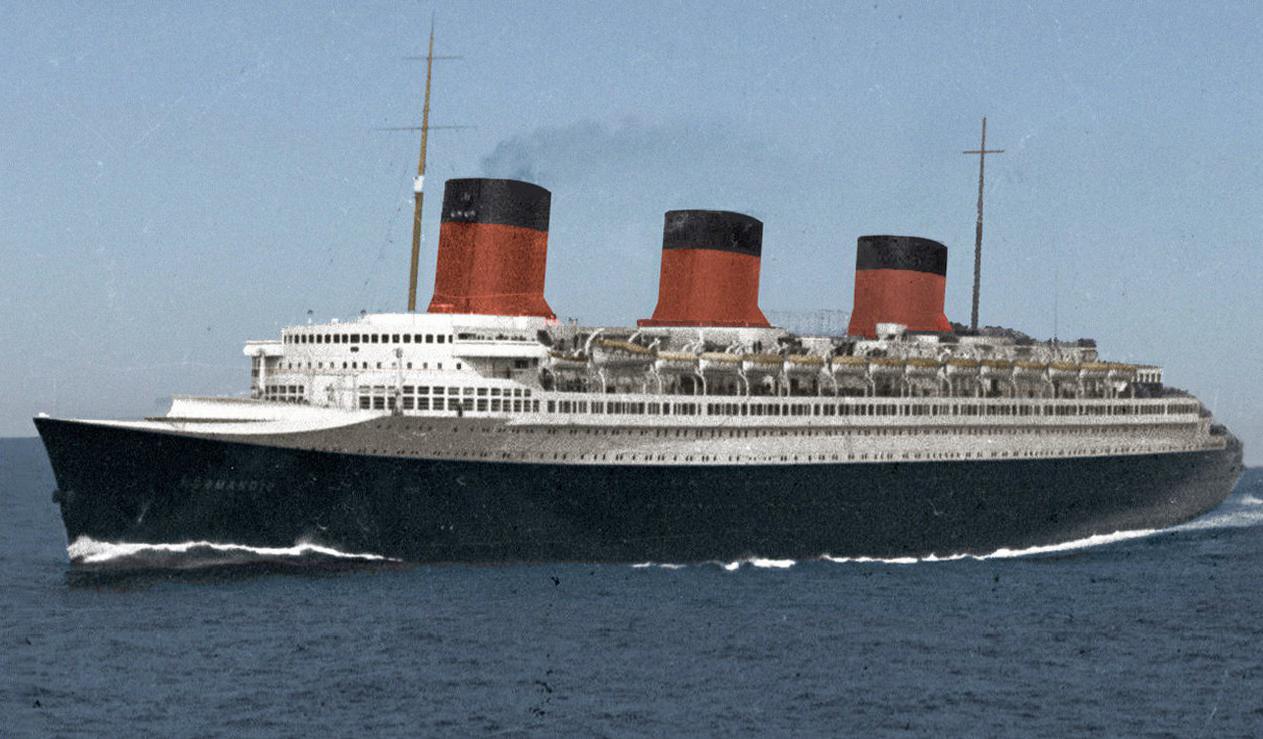
The SS Normandie was a French ocean liner constructed in Saint-Nazaire, France, by the Société Anonyme des Chantiers de Penhoët, beginning in 1931 and launched in 1932. She was designed to be a symbol of French maritime excellence, featuring a revolutionary hull with a slanting clipper-like bow and bulbous forefoot, conceived by Vladimir Yourkevitch. Her construction resulted in a 27,567-ton hull, which was the largest launched in France at the time and was later increased to approximately 83,423 GRT through modifications. Normandie’s interior was a masterpiece of Art Deco and Streamline Moderne style, designed by Pierre Patout, with lavish public spaces including a grand dining hall longer than the Hall of Mirrors at Versailles, capable of seating 700 passengers. Her interiors featured sculptures, murals, and luxurious suites, with the most opulent accommodations being the Deauville and Trouville apartments. The ship’s design emphasized elegance, with features such as a vast first-class lounge, a café grill, a theatre, indoor and outdoor pools, and even a regulation-sized outdoor tennis court—uncommon for ocean liners. Powered by a turbo-electric transmission system, she remains the most powerful steam turbo-electric passenger ship ever built. Her engines, supplied by Alsthom, enabled her to reach a top speed of over 32 knots, making her the fastest passenger vessel of her era and holder of the Blue Riband for the fastest transatlantic crossing. Her maiden voyage in 1935 saw her cross from Le Havre to New York in just over four days, setting a record for speed and earning widespread acclaim. Normandie was also notable for her rivalry with the RMS Queen Mary, with whom she contended for the Blue Riband and maritime prestige. She hosted numerous distinguished passengers, from authors like Hemingway and Colette to Hollywood stars, embodying the glamour of the Golden Age of ocean liners. Her service was cut short by World War II; seized by U.S. authorities, she was renamed USS Lafayette and converted into a troopship. In 1942, during her conversion, a fire severely damaged her, causing her to capsized and be left half-submerged in the Hudson River. Despite salvage efforts, she was deemed too costly to restore and was scrapped by 1948. Normandie’s design and luxurious interiors left a lasting legacy, influencing future ships and inspiring architectural elements worldwide. Many artifacts and design pieces from the vessel survive today, symbolizing her grandeur and innovation in ocean liner history.
This description has been generated using GPT-4.1-NANO based on the Vessel's wikidata information and then modified by ShipIndex.org staff.