
Akagi
1925 aircraft carrier initially laid down as a battlecruiser

Vessel Wikidata
* This information from Wikidata is available under the Creative Commons Attribution-ShareAlike License
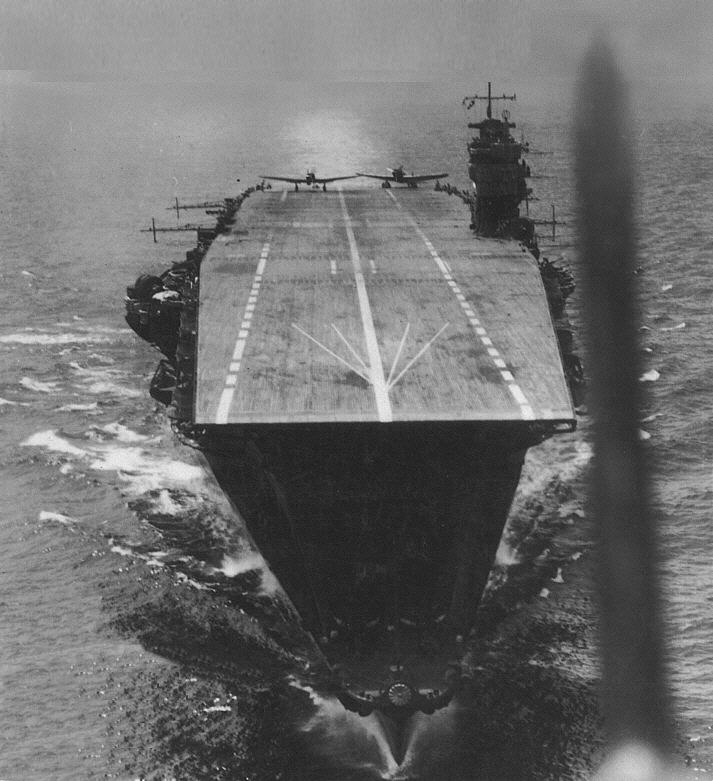
Akagi was a significant Japanese aircraft carrier of the Imperial Japanese Navy, notable for its size, design, and role in key naval battles. Originally laid down as an Amagi-class battlecruiser in December 1920 at Kure, Japan, her construction was halted in 1922 due to the Washington Naval Treaty, which limited battleship and battlecruiser construction. Instead, her incomplete hull was converted into an aircraft carrier, with construction resuming in 1923 and her launching occurring in 1925. She was commissioned in 1927, measuring approximately 261 meters (857 ft) in length, with a beam of 31 meters (101 ft 8 in), and a deep load displacement of around 34,364 long tons (34,920 t). Her crew numbered about 1,600. Akagi was unique in her design, featuring three superimposed flight decks—an uncommon configuration among carriers—and was equipped initially with a complement of 60 aircraft, including Mitsubishi B1M3 torpedo bombers, Nakajima A1N fighters, and Mitsubishi 2MR reconnaissance planes. Her armament included ten 20 cm (7.9 in) guns arranged in turrets and casemates for surface defense, along with anti-aircraft guns such as twin 12 cm (4.7 in) mounts. Her armor was modest, with a waterline belt reduced to 152 mm (6 in), and deck armor of 79 mm (3.1 in), reflecting her primary role as an aircraft platform rather than a surface combatant. Throughout her service, Akagi played a pivotal role in Japan's early Pacific campaigns, including the attack on Pearl Harbor, invasions of Rabaul and Java, and operations in the Indian Ocean. She was the flagship of the First Air Fleet, or Kido Butai, which pioneered Japan’s carrier strike doctrine emphasizing concentrated, massed air attacks. During the Battle of Midway in June 1942, Akagi participated in the initial bombardments but was severely damaged by American carrier aircraft, particularly from the USS Enterprise. A bomb hit ignited fires among her fueled aircraft, and she was eventually scuttled by her crew to prevent capture. Her loss marked a turning point in Pacific naval warfare, as Japan lost four of its six fleet carriers at Midway. The wreck of Akagi was discovered in 2019, lying upright at a depth of over 18,000 feet. Despite extensive damage, her remains are largely intact, serving as a poignant underwater monument to her historical significance.
This description has been generated using GPT-4.1-NANO based on the Vessel's wikidata information and then modified by ShipIndex.org staff.