
French battleship Liberté
1905 Liberté-class battleship
Vessel Wikidata
* This information from Wikidata is available under the Creative Commons Attribution-ShareAlike License
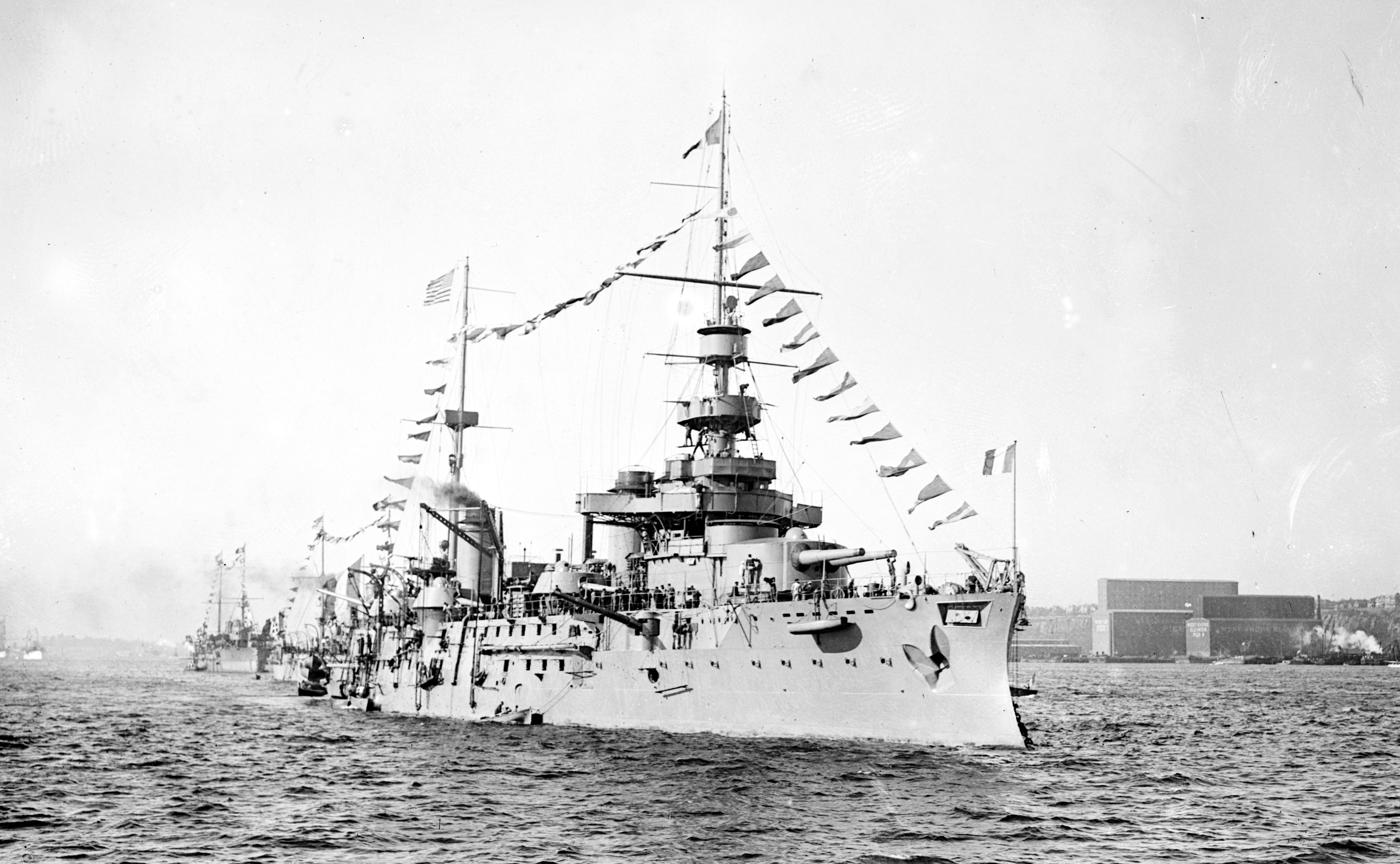
The French battleship Liberté was a pre-dreadnought vessel and the lead ship of her class, constructed in the early 1900s. She measured approximately 135.25 meters (443 ft 9 in) in length, with a beam of 24.25 meters (79 ft 7 in) and an average draft of 8.2 meters (26 ft 11 in). Displacing around 14,900 metric tons at full load, Liberté was powered by three vertical triple-expansion steam engines supplied by twenty-two Belleville boilers, designed to produce 17,500 metric horsepower and achieve a speed of 18 knots. Her range was notable, with a maximum of 8,400 nautical miles at 10 knots, supporting extended operations in the Mediterranean. Armament-wise, Liberté was equipped with a main battery of four 305 mm (12 in) guns mounted in twin turrets—one forward and one aft—providing substantial firepower. Her secondary armament consisted of ten 194 mm (7.6 in) guns, distributed across single turrets and casemates along the hull, complemented by thirteen 65 mm and ten 47 mm guns for defense against torpedo boats. She also carried two submerged 450 mm torpedo tubes. Her armor protection included a waterline belt of 280 mm (11 in) amidships, tapering to 180 mm (7.1 in) at the ends. The main turrets had up to 360 mm (14.2 in) of armor, with secondary turrets protected by 156 mm (6.1 in) armor, and the conning tower featuring 266 mm (10.5 in) sides. Laid down in November 1902 at the Ateliers et Chantiers de la Loire shipyard in Saint-Nazaire and launched on 19 April 1905, Liberté was completed by April 1908. She was assigned to the 2nd Division of the Mediterranean Squadron, based in Toulon, and participated in routine training, fleet maneuvers, and diplomatic visits, including representing France at the Hudson–Fulton Celebration in 1910. Tragically, Liberté’s career was cut short on 25 September 1911, when a magazine fire caused a catastrophic explosion that destroyed the ship, killing 286 crew members and wounding 188. The explosion was attributed to unstable Poudre B propellant, which had a history of causing similar accidents in the French Navy. Her wreck remained in Toulon harbor until 1925, when it was refloated, broken up, and disposed of, marking a somber chapter in France’s naval history.
This description has been generated using GPT-4.1-NANO based on the Vessel's wikidata information and then modified by ShipIndex.org staff.