
SMS Regensburg
1914 Graudenz-class cruiser
Vessel Wikidata
* This information from Wikidata is available under the Creative Commons Attribution-ShareAlike License
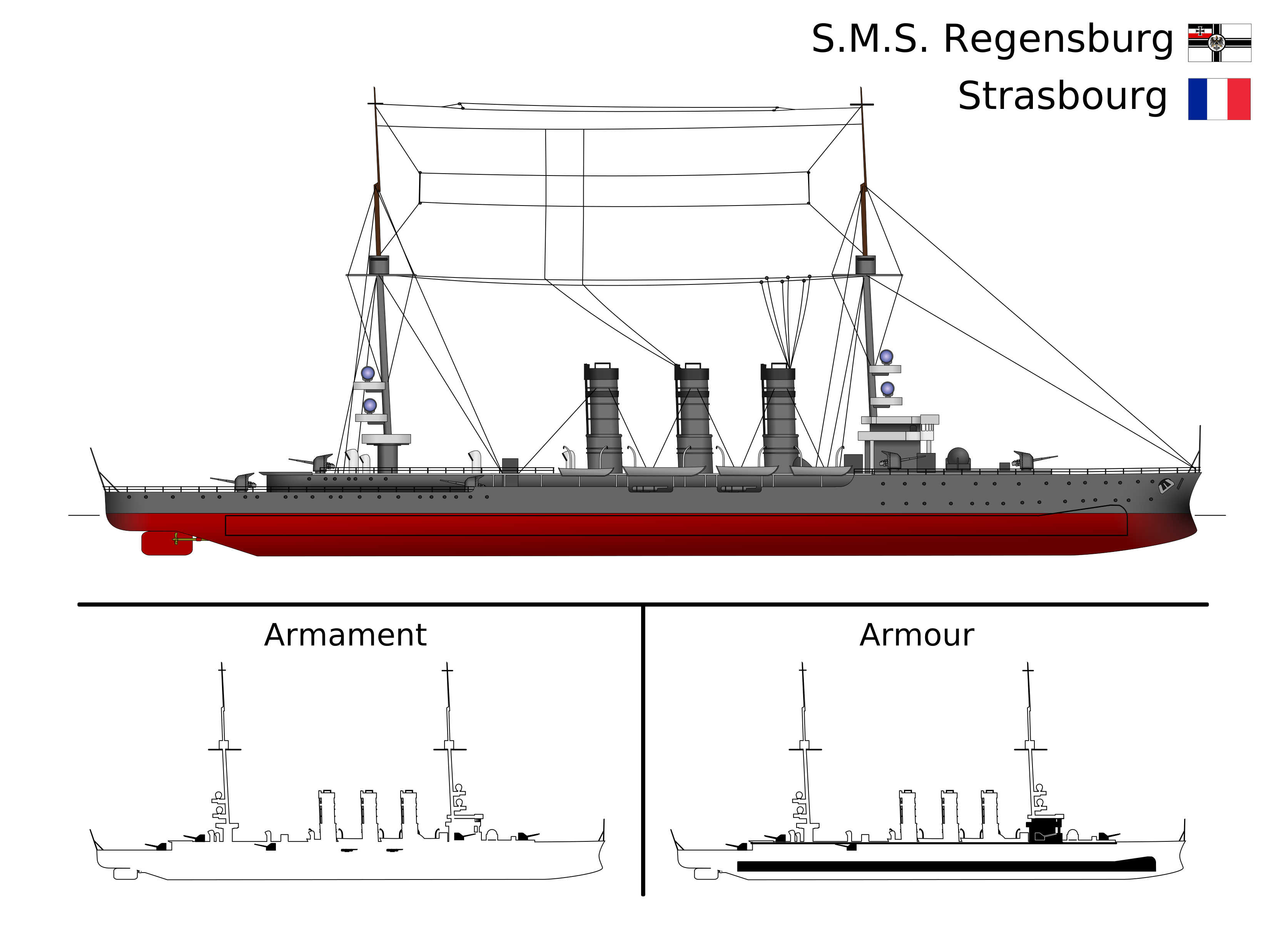
SMS Regensburg was a Graudenz-class light cruiser constructed by the German Kaiserliche Marine, representing a design that aimed to balance cost and operational capability during the early 20th century. Built at AG Weser shipyard in Bremen, she was laid down on 14 November 1912 and launched on 25 April 1914. Commissioned in January 1915, she measured approximately 142.7 meters in length overall, with a beam of 13.8 meters and a draft of 5.75 meters. Her displacement at full load was about 6,382 tons. The hull featured a relatively small superstructure with a conning tower, and her design included taller pole masts necessary for her role as a flotilla leader, along with a forecastle extending a third of her length. Propulsion was provided by two Marine steam turbines driving two 3.5-meter propellers, rated to produce 26,000 shaft horsepower, powered by ten coal-fired and two oil-fired boilers, enabling her to reach a top speed of 27.5 knots. Her fuel capacity allowed for a range of approximately 5,500 nautical miles at 12 knots. Armament initially consisted of twelve 10.5 cm SK L/45 guns, with later modifications replacing these with seven 15 cm SK L/45 guns and two 8.8 cm AA guns. She was also equipped with two submerged 50 cm torpedo tubes and could carry up to 120 mines. Regensburg’s armor protection included a 60 mm waterline belt amidships, a 60 mm curved armored deck, and a conning tower with 100 mm sides. Her operational history during WWI included participation in key naval engagements, notably the Battle of Jutland, where she served as the leader of torpedo boat flotillas screening the battlecruisers. She conducted patrols, mine-laying operations, and reconnaissance missions in the North Sea and Baltic, contributing to German naval efforts against the British Royal Navy. Following the war, she was ceded to France in 1920, renamed Strasbourg, and integrated into the French Navy. Her service included participation in the Rif War, Arctic rescue operations for the airship Italia, and search missions for Roald Amundsen. Decommissioned in 1936, she served as a barracks ship until seized by Germans in 1944, when she was scuttled in Lorient harbor to defend U-boat pens. Her wreck remains visible today, marking her maritime significance as a versatile vessel active throughout World War I and into the interwar period.
This description has been generated using GPT-4.1-NANO based on the Vessel's wikidata information and then modified by ShipIndex.org staff.