
HMS Engadine
1911 merchantman converted into a seaplane tender
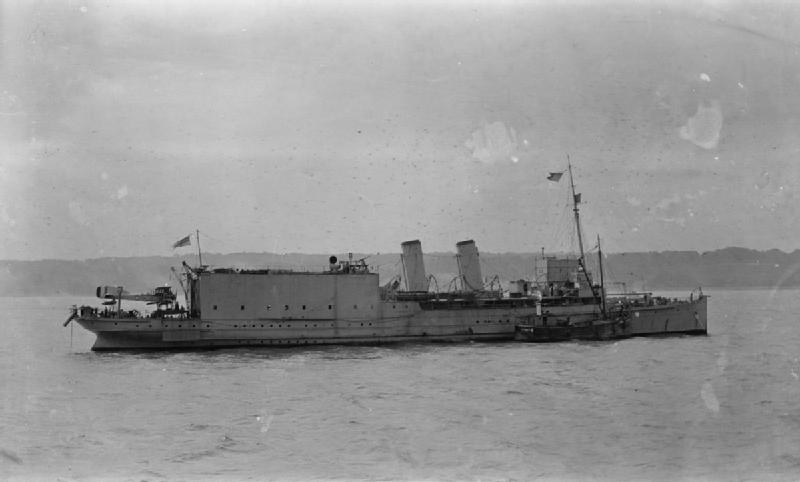
Vessel Wikidata
* This information from Wikidata is available under the Creative Commons Attribution-ShareAlike License
HMS Engadine was a seaplane tender serving in the Royal Navy during the First World War, originally built as the cross-Channel packet ship SS Engadine. She was constructed by William Denny and Brothers at their Dumbarton shipyard and launched on 23 September 1911. The vessel measured 323 feet (98.5 meters) in length, with a beam of 41 feet (12.5 meters) and a mean draught of 13 feet 8 inches (4.2 meters). She displaced approximately 2,550 long tons (2,590 metric tons) at deep load and was rated at 1,676 gross register tons (GRT). Her propulsion system comprised three sets of direct-drive steam turbines, each driving a single propeller shaft, powered by six boilers generating 13,800 shaft horsepower (10,300 kW). This allowed her to reach a maximum speed of 21.5 knots (39.8 km/h; 24.7 mph). She carried 400 tonnes (390 long tons) of coal, which provided a range of 1,250 nautical miles (2,320 km; 1,440 miles) at 15 knots. Initially designed as a fast packet for ferrying between Folkestone and Boulogne, SS Engadine was requisitioned by the Admiralty on 11 August 1914, and commissioned on 1 September 1914 after temporary modifications at Chatham Dockyard to accommodate seaplanes. She was fitted with three canvas hangars (one forward and two aft) and equipped with derricks for lowering aircraft into the sea, as she lacked a flight deck. Her initial crew numbered 197 officers and ratings, including 53 aviation personnel. During her wartime service, Engadine was involved in notable operations such as the Cuxhaven Raid in late 1914, where her seaplanes participated in attacking Zeppelin hangars. After her 1915 conversion, which increased her aircraft capacity to four and included mounting quick-firing guns for self-defense, she served mainly as a base ship and participated in reconnaissance efforts. Her most significant contribution was during the Battle of Jutland in 1916, where one of her aircraft conducted the first heavier-than-air reconnaissance mission during a naval battle, spotting German ships and relaying vital information. Engadine also played a role in rescuing the crippled armoured cruiser Warrior, which sank after being stranded with a jammed rudder. In 1918, she was transferred to the Mediterranean Fleet, based out of Malta, conducting anti-submarine patrols until the end of the war. After the war, she was sold back to her original owners in 1919, resuming her role as a cross-Channel ferry, and later passed to the Southern Railway in 1923. In 1933, she was sold to a Philippine company and renamed SS Corregidor. Her maritime history ended in December 1941 when she was sunk by a mine during the Japanese invasion of the Philippines, resulting in heavy loss of life and marking one of the most tragic maritime disasters in Philippine history.
This description has been generated using GPT-4.1-NANO based on the Vessel's wikidata information and then modified by ShipIndex.org staff.