
USS New Mexico
1917 New Mexico-class battleship
Vessel Wikidata
* This information from Wikidata is available under the Creative Commons Attribution-ShareAlike License
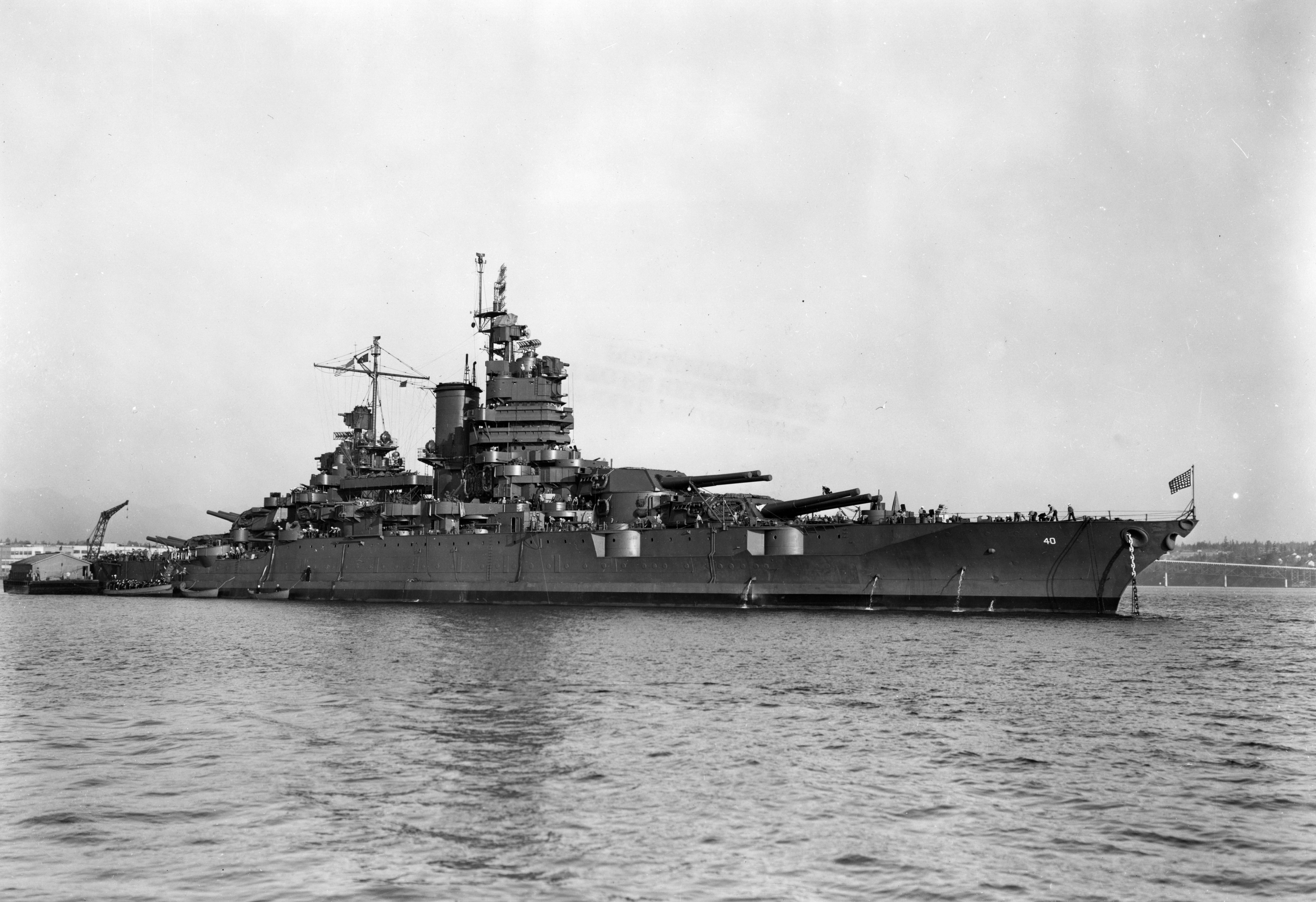
The USS New Mexico (BB-40) was a battleship of the United States Navy, serving from 1918 to 1946. As the lead ship of her class, she was notable for being the most advanced U.S. battleship of her time and the first equipped with turbo-electric transmission, enabling a maximum speed of 21 knots. She measured 624 feet in overall length, with a beam of approximately 97.5 feet and a draft of 30 feet. Her displacement ranged from 32,000 to 33,000 long tons at full load. Constructed at the New York Navy Yard, her keel was laid down on 14 October 1915, launched on 23 April 1917, and commissioned on 20 May 1918. Her armament included twelve 14-inch/50 caliber guns in four triple turrets, with two superfiring forward and two aft, and a secondary battery of fourteen 5-inch/51 caliber guns initially, later reduced, along with four 3-inch guns and two 21-inch torpedo tubes. Her main armor belt was 13.5 inches thick, with main gun turrets protected by 18 inches of armor. Her early service included escorting President Woodrow Wilson to France for the signing of the Treaty of Versailles and serving as the first flagship of the Pacific Fleet. During the interwar period, she underwent modernization from March 1931 to January 1933, replacing her turbo-electric drive with geared turbines and updating her anti-aircraft armament. She participated in various exercises and cruises, including a notable voyage to Australia and New Zealand in 1925. During World War II, USS New Mexico initially conducted neutrality patrols in the Atlantic before returning to the Pacific following Pearl Harbor. Her combat service was extensive, including shore bombardments at Attu, Kiska, Tarawa, the Marshall Islands, Mariana Islands, Leyte, Luzon, and Okinawa. She faced kamikaze attacks, suffering damage and casualties, including the death of her commanding officer, Captain Robert Walton Fleming. She also participated in the Japanese surrender ceremony at Tokyo Bay in September 1945. Decommissioned in July 1946, she was struck from the Naval Vessel Register in 1947 and sold for scrapping. Her dismantling was delayed by local protests in Newark, New Jersey, where efforts to block her scrapping led to a tense standoff known as the "Battle of Newark Bay." Ultimately, she was scrapped by July 1948. Her bells were donated to the state of New Mexico and the University of New Mexico, symbolizing her historical significance.
This description has been generated using GPT-4.1-NANO based on the Vessel's wikidata information and then modified by ShipIndex.org staff.