
HMS Defence
1907 Minotaur-class armoured cruiser
Vessel Wikidata
* This information from Wikidata is available under the Creative Commons Attribution-ShareAlike License
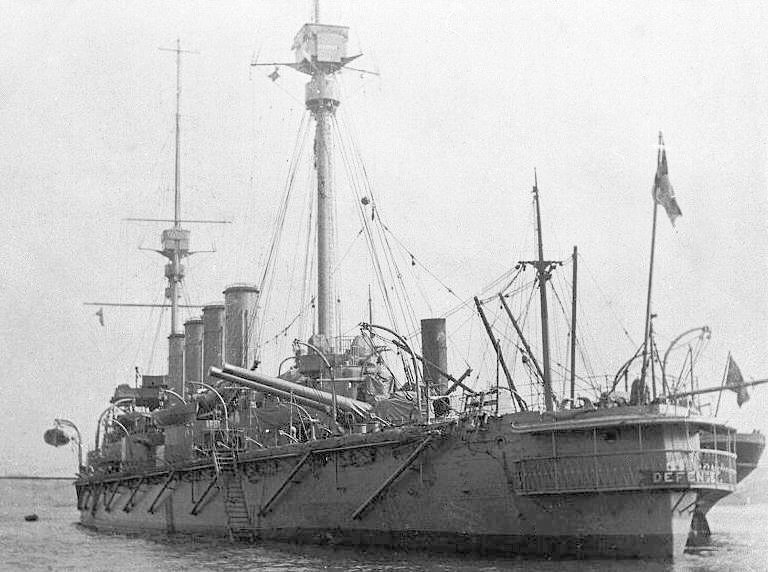
HMS Defence was a Minotaur-class armoured cruiser constructed for the Royal Navy, representing the last of its class built in the early 20th century. Laid down on 22 February 1905 at Pembroke Dock and launched on 27 April 1907, she was commissioned on 3 February 1909 at a cost of £1,362,970. The vessel measured 519 feet in length, with a beam of 74 feet 6 inches and a mean draught of 26 feet. Displacing 14,600 long tons at standard load and up to 16,630 long tons at deep load, Defence was powered by two quadruple-expansion steam engines producing 27,000 indicated horsepower, which enabled her to reach a top speed of 23 knots. Her propulsion system included 24 Yarrow water-tube boilers, and she could carry up to 2,060 long tons of coal supplemented by 750 long tons of fuel oil, allowing her to steam approximately 8,150 nautical miles at 10 knots. Armament comprised four BL 9.2-inch Mark X guns in twin turrets fore and aft, supplemented by ten BL 7.5-inch Mark II guns amidships in single turrets, and sixteen QF 12-pounder guns for anti-torpedo boat defence. She also carried five submerged 17.7-inch torpedo tubes, including one at the stern. Her armor protection included a waterline belt of 6 inches of Krupp cemented armor, with gun turrets and barbettes protected by 6–8 inches of armor, and a conning tower with 10 inches of armor. Defence’s service history saw her stationed in the Mediterranean at the outbreak of World War I, where she participated in the pursuit of the German ships SMS Goeben and SMS Breslau. She later transferred to the Grand Fleet in January 1915 and served as the flagship of the First Cruiser Squadron. Notably, she escorted the royal yacht RMS Medina during King George V’s trip to India. During the Battle of Jutland on 31 May 1916, Defence served as the flagship of Rear-Admiral Sir Robert Arbuthnot and was positioned on the starboard flank of the cruiser screen. She engaged German ships during the battle but was fatally struck by two salvoes from German battlecruisers, which caused her rear magazine to explode. The ship sank rapidly, with all hands believed to have been lost, approximately 900 men. Her wreck was discovered in 1984 and found to be largely intact, and she was later designated a protected site under the Protection of Military Remains Act 1986. HMS Defence remains a significant symbol of early 20th-century naval design and the Battle of Jutland.
This description has been generated using GPT-4.1-NANO based on the Vessel's wikidata information and then modified by ShipIndex.org staff.