
USS San Jacinto
Screw frigate in the US Navy famous for her role in the Trent Affair of 1861
Vessel Wikidata
* This information from Wikidata is available under the Creative Commons Attribution-ShareAlike License
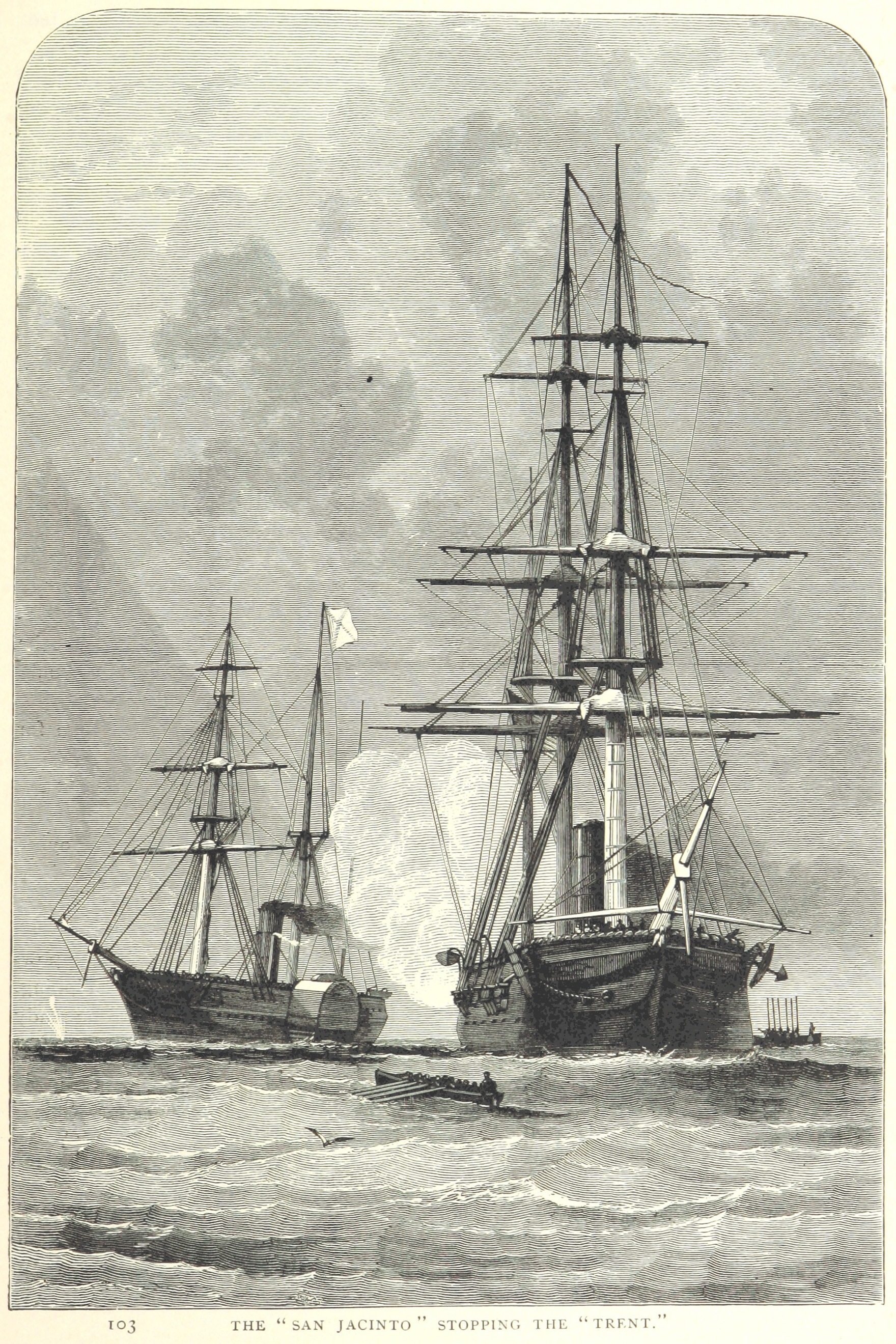
The USS San Jacinto was an early screw frigate constructed for the United States Navy, launched on 16 April 1850 at the New York Navy Yard. Designed as an experimental vessel to test new propulsion technologies, she was characterized by her screw propeller, although her machinery was plagued by unreliability and operational issues throughout her career. Her dimensions and specific engineering details are not provided in the source, but her role as a steam-powered frigate highlights her technological significance during the mid-19th century. San Jacinto's service history was marked by numerous deployments across the globe. She sailed from New York in early 1852, initially testing her engines during trial runs and later deploying to European waters, including Cádiz, Spain, and Southampton, England. Her engine troubles persisted, leading to repairs and reinstallation of machinery in Philadelphia in 1853 and subsequent recommissioning in 1854. She served briefly in the West Indies Squadron in 1855, where she supported diplomatic efforts with Siam and Japan, notably helping establish the first American diplomatic presence in Japan and negotiating the Treaty of Amity and Commerce. During the Second Opium War, San Jacinto participated in the bombardment of Chinese forts at Canton, helping to secure American interests in China. She also operated in African waters with the Africa Squadron, capturing the slaver brig Storm King off the Congo River in 1860. Her involvement in the American Civil War was extensive; she conducted blockades along Confederate ports, engaged in pursuit of Confederate commerce raiders such as CSS Alabama, and was notably involved in the Trent Affair of 1861, where she intercepted British mail packet Trent and captured Confederate envoys James Mason and John Slidell, causing a diplomatic crisis. Throughout the Civil War, San Jacinto served as flagship for various blockading squadrons, participating in key operations including the destruction of Confederate forts and supporting Union land campaigns. Her service was periodically interrupted by outbreaks of yellow fever, which led to her departure from active duty for health reasons. Her final mission ended on 1 January 1865, when she struck a reef near Great Abaco Island, leading to her sinking. Her hulk was sold in Nassau in 1871. The USS San Jacinto remains a notable example of early steam frigates and their role in mid-19th century naval operations, diplomacy, and technological experimentation.
This description has been generated using GPT-4.1-NANO based on the Vessel's wikidata information and then modified by ShipIndex.org staff.