
BRP Gregorio Velasquez
oceanographic research ship
Vessel Wikidata
* This information from Wikidata is available under the Creative Commons Attribution-ShareAlike License
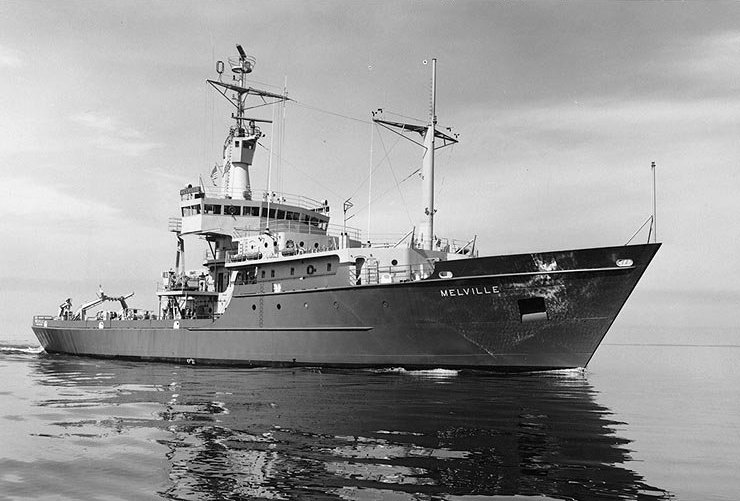
The BRP Gregorio Velasquez (AGR-702) is the Philippine Navy’s first oceanographic research vessel, originally constructed as the USNS Melville (T-AGOR-14) by the Defoe Shipbuilding Company in Bay City, Michigan. Laid down on July 12, 1967, and launched on July 10, 1968, the vessel was completed and delivered to the U.S. Navy on August 1, 1969. It served primarily as a research vessel operated by the Scripps Institution of Oceanography under the Office of Naval Research, as part of the University-National Oceanographic Laboratory System (UNOLS). Designed as a versatile, general-purpose oceanographic ship, Melville boasted a length of 279 feet, a beam of 46 feet, and a draft of 16.6 feet. Its original propulsion system featured a cycloidal drive, allowing exceptional maneuverability, including sideways movement—a technology that contributed to its selection for the 1976 "King Kong" movie. The vessel's displacement was approximately 2,944 tons after a 1992 service life extension, which included hull lengthening and installation of a new advanced twin diesel-electric propulsion system with Z-Drive Lips and a retractable azimuthing thruster, enhancing its operational capabilities. Melville’s notable achievements include leading the 1979 RISE expedition, which discovered deep-sea hydrothermal vents along the East Pacific Rise. Throughout its career, the vessel sailed over 1.5 million miles and crossed the equator more than 90 times, supporting scientific missions worldwide. Its sister ship, R/V Knorr, is renowned for locating the Titanic wreck in 1985. After 45 years of service, Melville underwent a final service life extension in 1992, but by September 2014, it reached the end of its operational lifespan. The vessel was decommissioned in 2015 and transferred to the Philippine Navy as an Excess Defense Article. On April 29, 2016, it was officially commissioned as BRP Gregorio Velasquez, named after the Filipino scientist, and equipped to support hydrographic surveying and maritime research, marking a significant enhancement of the Philippines’ naval scientific capabilities.
This description has been generated using GPT-4.1-NANO based on the Vessel's wikidata information and then modified by ShipIndex.org staff.