
USS Gunston Hall
1943 Ashland-class dock landing ship
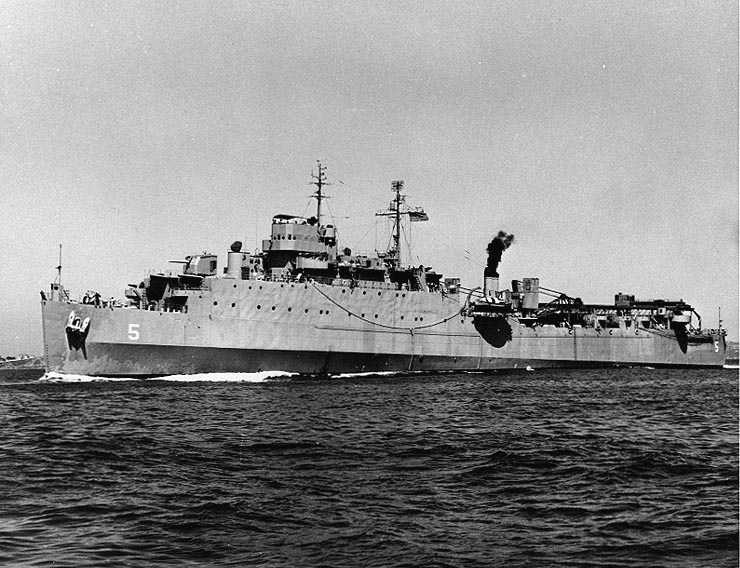
Vessel Wikidata
* This information from Wikidata is available under the Creative Commons Attribution-ShareAlike License
The USS Gunston Hall (LSD-5) was an Ashland-class dock landing ship constructed by the Moore Dry Dock Company in Oakland, California. Launched on May 1, 1943, and commissioned on November 10, 1943, she served as a versatile amphibious warfare vessel during World War II and the Korean War, later serving in the Argentine Navy as ARA Cándido de Lasala (Q-43). Designed to carry and deploy landing craft, tanks, and troops, the Gunston Hall had a reinforced hull and was equipped to support amphibious operations across the Pacific and later in Arctic conditions following her conversion under project SCB 29. Her dimensions and specific displacement are not detailed here, but as an Ashland-class LSD, she was built for large-scale amphibious assaults. Her initial shakedown along the California coast prepared her for extensive combat service in the Pacific Theater, where she participated in every major invasion from February 1944 through the end of WWII. These included the assaults on Kwajalein, Emirau, Hollandia, Guam, Peleliu, Leyte, Luzon, Iwo Jima, and Okinawa, supporting Marine and Army troops with cargo, landing craft, and repair services. Notably, she was present during the Battle for Leyte Gulf and remained at Okinawa until July 1945 to repair small craft, surviving kamikaze attacks unscathed. Post-WWII, she took part in Operation Crossroads at Bikini Atoll, supporting atomic bomb tests in 1946. She was decommissioned in 1947 but later recommissioned in 1949 after Arctic modifications to operate in colder climates. During the Korean War, Gunston Hall transported troops, supplies, and prisoners, notably during the Inchon landing and in operations at Wanson Harbor, North Korea. She was further refitted to carry helicopters, enhancing her amphibious capabilities. Her later service included humanitarian missions during Operation Passage to Freedom in Vietnam, evacuating North Vietnamese refugees. During the Cuban Missile Crisis in 1962, she was mobilized in the Caribbean. Throughout the 1960s, she supported operations in Vietnam, providing logistical support and troop transport. In 1970, she was sold to Argentina, where she served until decommissioning in 1981. Her career highlights include nine battle stars in WWII and nine in Korea, marking her as a significant vessel in mid-20th-century amphibious warfare history.
This description has been generated using GPT-4.1-NANO based on the Vessel's wikidata information and then modified by ShipIndex.org staff.