
HMAS Berrima
passenger liner which served in the Royal Australian Navy during World War I as an armed merchantman and troop transport
Vessel Wikidata
* This information from Wikidata is available under the Creative Commons Attribution-ShareAlike License
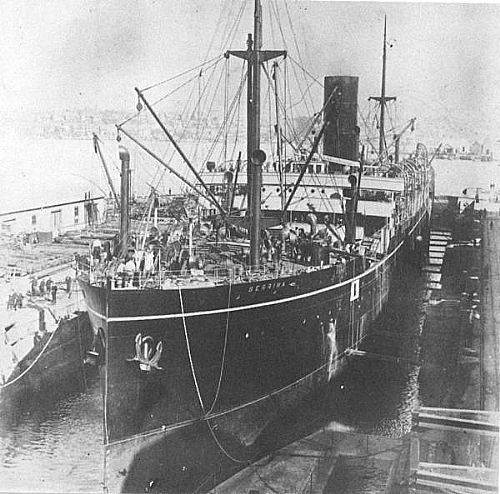
HMAS Berrima was originally a passenger liner built by Caird & Company in Greenock, launched on 20 September 1913 and delivered to the Peninsular and Oriental Steam Navigation Company (P&O) on 5 December 1913. The vessel measured 11,137 gross register tons and was designed for emigrant service between the United Kingdom and Australia via Cape Town, reflecting its role in long-distance passenger and immigrant transport. The ship was approximately 500 feet 2 inches (152.45 meters) in length, with a beam of 62 feet 3 inches (18.97 meters) and a draught of 38 feet (12 meters). Its propulsion system comprised two 4-cylinder quadruple expansion steam engines generating 9,000 indicated horsepower, driving twin screws, and enabling a maximum speed of 14 knots. In her civilian service, Berrima was equipped to carry up to 350 third-class passengers permanently, with additional capacity for 250 more in temporary accommodations. The vessel’s maiden voyage departed London in December 1913, calling at Cape Town, Adelaide, Melbourne, and Sydney. With the outbreak of World War I, Berrima was requisitioned in August 1914 and underwent a rapid refit at Cockatoo Island Dockyard. Instead of being converted solely into a troopship, she was fitted with four 4-inch naval guns and converted into an armed auxiliary cruiser, commissioned as HMAS Berrima under Commander J.B. Stevenson. She played a significant role in early military operations, transporting troops of the Australian Naval and Military Expeditionary Force to German New Guinea and participating in landings at Herbertshöhe, Rabaul, and Madang, earning the battle honour "Rabaul 1914" in 2010. After her brief combat service, Berrima was paid off in October 1914, but was quickly converted into a troop transport, sailing to the Middle East in December 1914 while towing the submarine AE2. She continued service as a troopship until February 1917, when she was torpedoed off Portland by a German U-boat, resulting in the loss of four lives. She was subsequently towed ashore, repaired, and pressed into service as a stores and munitions ferry under the Shipping Controller. Post-war, Berrima resumed commercial service with P&O in 1920, operating on the UK-Australia route until her withdrawal in 1929. She was sold for scrap in 1930 to Japanese shipbreakers. Her service history highlights her versatility and significance in both wartime operations and maritime commercial activity during the early 20th century.
This description has been generated using GPT-4.1-NANO based on the Vessel's wikidata information and then modified by ShipIndex.org staff.