
HMS Exeter
1929 York-class heavy cruiser
Vessel Wikidata
* This information from Wikidata is available under the Creative Commons Attribution-ShareAlike License
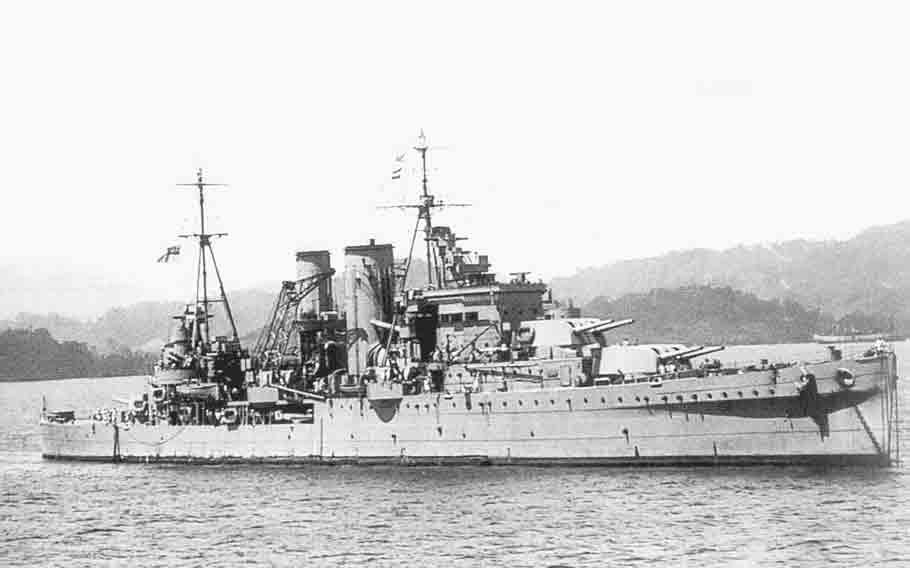
HMS Exeter was a York-class heavy cruiser constructed for the Royal Navy in the late 1920s. She displaced approximately 8,390 long tons at standard load and about 10,620 long tons at deep load. The vessel measured 575 feet 1 inch (175.3 meters) in length, with a beam of 58 feet (17.7 meters) and a draught of 20 feet 3 inches (6.2 meters). Her propulsion system comprised four Parsons geared steam turbines driven by eight Admiralty 3-drum boilers, producing a total of 80,000 shaft horsepower, which allowed her to reach a maximum speed of 32 knots (59 km/h). The cruiser carried a fuel oil capacity of 1,900 long tons, enabling a range of 10,000 nautical miles at 14 knots. Her complement consisted of 628 officers and ratings. Exeter's main armament included six BL eight-inch (203 mm) Mk VIII guns in three twin turrets ("A," "B," and "Y"), with "A" and "B" turrets superfiring forward and "Y" aft. She was also equipped with four QF four-inch (102 mm) Mk V anti-aircraft guns, two twin-gun mounts, and two quadruple mounts for Vickers 0.5-inch (12.7 mm) machine guns, later replaced by other AA weapons. Her defensive armor was partial; sides of boiler and engine rooms had 3 inches (76 mm) of armor, with magazines protected by 5.5 inches (140 mm). The ship's design was updated from her sister ship York, including increased beam, trunked boiler uptakes, streamlined enclosed bridge, and the installation of fixed aircraft catapults. Exeter’s service history was marked by notable engagements. She participated in the Battle of the River Plate in 1939 against the German heavy cruiser Admiral Graf Spee, suffering severe damage that kept her under repair for over a year. During World War II, she served in multiple theaters, including South American waters, the Indian Ocean, and the Pacific. She escorted convoys, participated in the Malayan Campaign, and was part of the ABDA command during the Battle of the Java Sea in 1942. She was heavily damaged during this engagement, hit by multiple shells and torpedoes, and ultimately scuttled by her crew to prevent capture. The sinking resulted in the loss of most of her crew, with 652 survivors rescued by Japanese forces. Her wreck was discovered in 2007, lying on her starboard side at a depth of about 200 feet, but was later destroyed by illegal salvagers by 2016. HMS Exeter remains a significant vessel in maritime history, particularly for her role in early WWII naval battles and her tragic end at sea.
This description has been generated using GPT-4.1-NANO based on the Vessel's wikidata information and then modified by ShipIndex.org staff.